
|
You entered: NASA
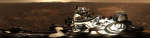 Mars Perseverance Sol 3
26.02.2021
Stitched together on planet Earth, 142 separate images make up this 360 degree panorama from the floor of Jezero Crater on Mars. The high-resolution color images were taken by the Perseverance rover's zoomable Mastcam-Z during mission sol 3, also known as February 21, 2021.
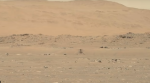 Ingenuity: First Flight over Mars
20.04.2021
What's the best way to explore Mars? Perhaps there is no single best way, but a newly demonstrated method shows tremendous promise: flight. Powered flight has the promise to search vast regions and scout out particularly interesting areas for more detailed investigation.
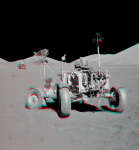 Apollo 17 VIP Site Anaglyph
17.12.2022
Get out your red/blue glasses and check out this stereo scene from Taurus-Littrow valley on the Moon! The color anaglyph features a detailed 3D view of Apollo 17's Lunar Rover in the foreground -- behind it lies the Lunar Module and distant lunar hills.
 APOD: 2023 June 19 Б The Busy Center of the Lagoon Nebula
19.06.2023
The center of the Lagoon Nebula is a whirlwind of spectacular star formation. Visible near the image center, at least two long funnel-shaped clouds, each roughly half a light-year long, have been formed by extreme stellar winds and intense energetic starlight. A tremendously bright nearby star, Herschel 36, lights the area.
 APOD: 2025 April 6 Б Moonquakes Surprisingly Common
6.04.2025
Why are there so many moonquakes? Analyses of seismometers left on the moon during the Apollo moon landings reveal a surprising number of moonquakes occurring within 100 kilometers of the surface. In fact, 62 moonquakes were detected in data recorded between 1972 and 1977.
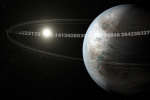 APOD: 2026 March 14 Б A Year for K2-315b
14.03.2026
Want to visit a planet that has 3.14 days in a year? Then plan a trip to K2-315b, an earth-sized planet orbiting around a cool, red, M dwarf star about once every 3.14 days.
 At the Core of M15
20.11.1995
Densely packed stars in the core of the globular cluster M15 are shown in this Hubble Space Telescope (HST) image taken in April of 1994. The stars revealed are contained in an area 1.6 light years across and their colors roughly indicate their temperatures - hot stars appear blue, cooler stars look reddish-orange.
 Tracking Saturn's Moons
12.05.1996
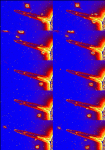
These five pairs of Hubble Space Telescope images track some of Saturn's moons as they orbit the ringed planet. A pair of images was taken every 97 minutes on November 21, 1995 with the Wide Field Planetary Camera-2, the normally bright ring system appearing nearly edge-on.
 M2 9: Wings of a Butterfly Nebula
27.12.1998
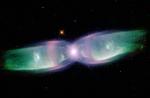
Are stars better appreciated for their art after they die? Actually, stars usually create their most artistic displays as they die. In the case of low-mass stars like our Sun and M2-9 pictured above, the stars transform themselves from normal stars to white dwarfs by casting off their outer gaseous envelopes.
 M2 9: Wings of a Butterfly Nebula
12.06.2005
Are stars better appreciated for their art after they die? Actually, stars usually create their most artistic displays as they die. In the case of low-mass stars like our Sun and M2-9 pictured above, the stars transform themselves from normal stars to white dwarfs by casting off their outer gaseous envelopes.
|
January February March April May June July August September October |
|||||||||||||||||||||||||||||||||||||||||||||||||