
|
You entered: NASA
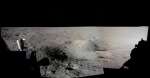 Apollo 11 Landing Site Panorama
30.08.2012
Have you seen a panorama from another world lately? Assembled from high-resolution scans of the original film frames, this one sweeps across the magnificent desolation of the Apollo 11 landing site on the Moon's Sea of Tranquility.
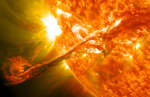 A Solar Filament Erupts
17.09.2012
What's happened to our Sun? Nothing very unusual -- it just threw a filament. At the end of last month, a long standing solar filament suddenly erupted into space producing an energetic Coronal Mass Ejection (CME).
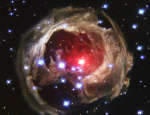 Light Echoes from V838 Mon
17.03.2013
What caused this outburst of V838 Mon? For reasons unknown, star V838 Mon's outer surface suddenly greatly expanded with the result that it became the brightest star in the entire Milky Way Galaxy in January 2002. Then, just as suddenly, it faded.
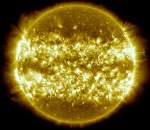 A Year on the Sun
26.04.2013
Our solar system's miasma of incandescent plasma, the Sun may look a little scary here. The picture is a composite of 25 images recorded in extreme ultraviolet light by the orbiting Solar Dynamics Observatory between April 16, 2012 and April 15, 2013.
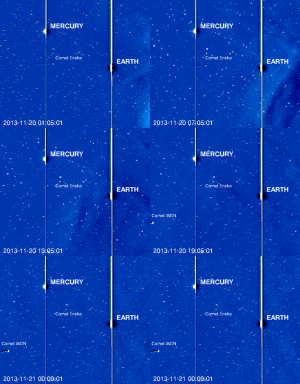 Comet ISON from STEREO
23.11.2013
Still intact, on November 21 Comet ISON (C/2012 S1) swept into this animated field of view (left) from the HI-1 camera on the STEREO-A spacecraft. The camera has also captured periodic Comet Encke, Mercury, and Earth, with the Sun cropped out of the frame at the right, the source of the billowing solar wind.
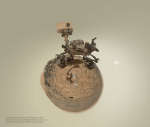 Little Planet Curiosity
22.08.2015
A curious robot almost completely straddles this rocky little planet. Of course, the planet is really Mars and the robot is the car-sized Curiosity Rover, posing over its recent drilling target in the Marias Pass area of lower Mount Sharp.
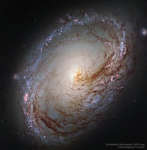 Spiral Galaxy M96 from Hubble
21.09.2015
Dust lanes seem to swirl around the core of Messier 96 in this colorful, detailed portrait of the center of a beautiful island universe. Of course M96 is a spiral galaxy, and counting...
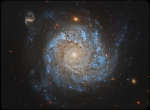 NGC 1309: Spiral Galaxy and Friends
14.07.2016
A gorgeous spiral galaxy some 100 million light-years distant, NGC 1309 lies on the banks of the constellation of the River (Eridanus). NGC 1309 spans about 30,000 light-years, making it about one third the size of our larger Milky Way galaxy.
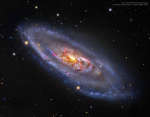 M106: A Spiral Galaxy with a Strange Center
17.03.2019
What's happening at the center of spiral galaxy M106? A swirling disk of stars and gas, M106's appearance is dominated by blue spiral arms and red dust lanes near the nucleus, as shown in the featured image.
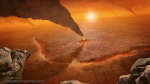 Venusian Volcano Imagined
27.10.2020
What would an erupting volcano on Venus look like? Evidence of currently active volcanoes on Venus was announced earlier this year with the unexplained warmth of regions thought to contain only ancient volcanoes. Although...
|
January February March April May June July August September October |
|||||||||||||||||||||||||||||||||||||||||||||||||