
|
You entered: dark
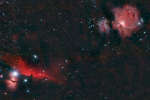 Horsehead and Orion Nebulae
10.03.2009
Adrift 1,500 light-years away in one of the night sky's most recognizable constellations, the glowing Orion Nebula and the dark Horsehead Nebula are contrasting cosmic vistas. They appear in opposite corners of this stunning mosaic taken with a digital camera attached to a small telescope.
 APOD: 2024 September 10 Б Horsehead and Orion Nebulas
10.09.2024
The dark Horsehead Nebula and the glowing Orion Nebula are contrasting cosmic vistas. Adrift 1,500 light-years away in one of the night sky's most recognizable constellations, they appear in opposite corners of the above stunning mosaic.
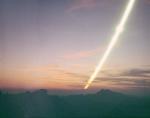 A Setting Sun Trail
29.07.2002
The Sun appears to move on the sky because the Earth rotates. The extreme brightness of the Sun, however, makes it difficult to capture a sun-trail -- the path the Sun traces on the sky.
 Total Solar Eclipse Below the Bottom of the World
5.12.2021
Yesterday there was a total solar eclipse visible only at the end of the Earth. To capture the unusual phenomenon, airplanes took flight below the clouded seascape of Southern Ocean. The featured image shows...
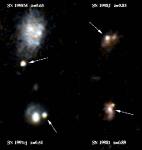 The Year of Distant Supernovae
31.12.1998
Distant supernovae were among topics at the forefront of astronomy during 1998. Two independent groups raced to deploy large telescopes to scan the sky, discovering and analyzing far-off supernovae with the promise of calibrating the geometry of our universe.
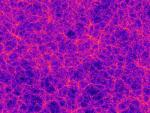 The Universe in Hot Gas
20.08.2002
Where is most of the normal matter in the Universe? Recent observations from the Chandra X-ray Observatory confirm that it is in hot gas filaments strewn throughout the universe. "Normal matter" refers to known elements and familiar fundamental particles.
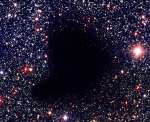 Molecular Cloud Barnard 68
29.01.2012
Where did all the stars go? What used to be considered a hole in the sky is now known to astronomers as a dark molecular cloud. Here, a high concentration of dust and molecular gas absorb practically all the visible light emitted from background stars.
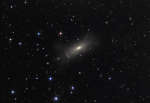 Shell Galaxy NGC 7600
23.12.2011
Similar in size to the Milky Way, elliptical galaxy NGC 7600 is about 150 thousand light-years distant. In this deep image, spanning about 1/2 degree on the sky toward the constellation Aquarius, NGC 7600 sports a remarkable outer halo of nested shells and broad circumgalactic structures.
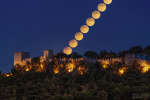 Harvest Moon Eclipse
23.09.2016
A Harvest Moon rises over Sesimbra Castle south of Lisbon in this impressive series of telephoto exposures. Captured at its full phase, the golden Moon was also gliding through the Earth's more diffuse outer shadow during September's penumbral lunar eclipse. The eclipse shading is subtle compared to a total lunar eclipse.
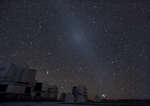 The Gegenschein Over Chile
2.12.2012
Is the night sky darkest in the direction opposite the Sun? No. In fact, a rarely discernable faint glow known as the gegenschein (German for "counter glow") can be seen 180 degrees around from the Sun in an extremely dark sky. The gegenschein is sunlight back-scattered off small interplanetary dust particles.
|
January February March April May June July August September |
|||||||||||||||||||||||||||||||||||||||||||||||||