
|
You entered: dark
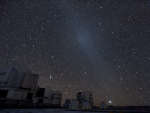 The Gegenschein Over Chile
7.05.2008
Is the night sky darkest in the direction opposite the Sun? No. In fact, a rarely discernable faint glow known as the gegenschein (German for "counter glow") can be seen 180 degrees around from the Sun in an extremely dark sky. The gegenschein is sunlight back-scattered off small interplanetary dust particles.
 APOD: 2024 January 1 Б NGC 1232: A Grand Design Spiral Galaxy
1.01.2024
Galaxies are fascinating not only for what is visible, but for what is invisible. Grand spiral galaxy NGC 1232, captured in detail by one of the Very Large Telescopes, is a good example.
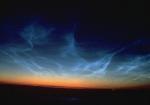 Noctilucent Clouds
19.06.2005
Sometimes it's night on the ground but day in the air. As the Earth rotates to eclipse the Sun, sunset rises up from the ground. Therefore, at sunset on the ground, sunlight still shines on clouds above.
 A Milky Way Band
10.07.2011
Most bright stars in our Milky Way Galaxy reside in a disk. Since our Sun also resides in this disk, these stars appear to us as a diffuse band that circles the sky.
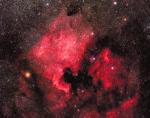 The North America Nebula
1.05.2000
Here's a familiar shape in an unfamiliar location! This emission nebula is famous partly because it resembles Earth's continent of North America. To the right of the North America Nebula, cataloged as NGC 7000, is a less luminous Pelican Nebula.
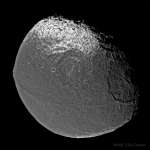 APOD: 2023 February 26 Б Saturns Iapetus: Moon with a Strange Surface
26.02.2023
What would make a moon look like a walnut? A strange ridge that circles Saturn's moon Iapetus's equator, visible near the bottom of the featured image, makes it appear similar to a popular edible nut.
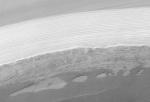 Water Ice Imaged in Martian Polar Cap
19.02.2002
Does water exist today on Mars? Yes, although the only place on Mars known to have water is the North Polar Cap, and that water is frozen. Views of this potentially life-enabling water-ice are usually obscured -- in the winter by darkness and in the summer by clouds.
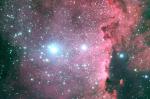 Hot Stars in the Southern Milky Way
7.05.1999
Hot blue stars, red glowing hydrogen gas, and dark, obscuring dust clouds are strewn through this dramatic region of the Milky Way in the southern constellation of Ara (the Altar). About 4,000 light-years from Earth, the stars at the left are young, massive, and energetic.
 Hot Stars in the Southern Milky Way
22.12.2001
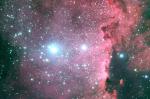
Hot blue stars, red glowing hydrogen gas, and dark, obscuring dust clouds are strewn through this dramatic region of the Milky Way in the southern constellation of Ara (the Altar). About 4,000 light-years from Earth, the stars at the left are young, massive, and energetic.
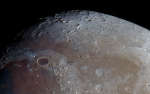 Mare Frigoris
8.10.2020
Lighter than typically dark, smooth, mare the Mare Frigoris lies in the far lunar north. Also known as the Sea of Cold, it stretches across the familiar lunar nearside in this close up of the waxing gibbous Moon's north polar region. Dark-floored, 95 kilometer wide crater Plato is just left of the center.
|
January February March April May June July August September |
|||||||||||||||||||||||||||||||||||||||||||||||||