
|
You entered: dark
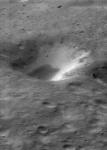 A Two Toned Crater on Asteroid Eros
22.01.2001
What lies beneath the surface of asteroid Eros? This image taken two weeks ago by the robot NEAR spacecraft orbiting the dark asteroid shows a kilometer-wide crater where some type of light material lies beneath some of the darker surface regolith.
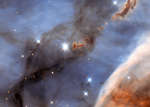 Evaporating Blobs of the Carina Nebula
23.04.2012
No, they are not alive -- but they are dying. The unusual blobs found in the Carina nebula, some of which are seen floating on the upper right, might best be described as evaporating. Energetic light and winds from nearby stars are breaking apart the dark dust grains that make the iconic forms opaque.
 M7: Open Star Cluster in Scorpius
13.07.2016
M7 is one of the most prominent open clusters of stars on the sky. The cluster, dominated by bright blue stars, can be seen with the naked eye in a dark sky in the tail of the constellation of the Scorpion (Scorpius).
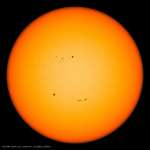 Live: Watching for Venus to Cross the Sun
5.06.2012
Today Venus moves in front of the Sun. One way to follow this rare event is to actively reload the above live image of the Sun during the right time interval and look for an unusual circular dark dot. The smaller sprawling dark areas are sunspots. The circular dot is the planet Venus.
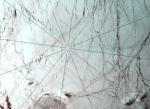 North Pole Below
20.10.2000
Orbiting over the north pole of planet Earth on May 5, the MODIS instrument on-board the Terra spacecraft, recorded this view of the ice cap 700 kilometers below. A radial grid centered on the pole is shown on top of the approximately true color image where each pixel covers about one square kilometer.
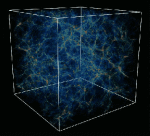 Simulating the Universe
8.11.1995
The above cube represents a chunk of our universe as simulated by the Grand Challenge Cosmology Consortium (GC3). The cube is huge - it would take light 500 million years to cross it. Low density gas is shown as blue, and high density gas as red.
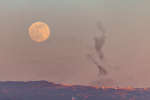 The Full Moon and the Dancer
22.01.2022
On Monday, January's Full Moon rose as the Sun set. Spotted near the eastern horizon, its warm hues are seen in this photo taken near Cagliari, capital city of the Italian island of Sardinia.
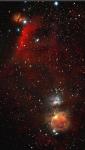 Orion Nebulosities
30.05.2002
Adrift 1,500 light-years away in one of the night sky's most recognizable constellations, the glowing Orion Nebula and the dark Horsehead Nebula are contrasting cosmic vistas. They both appear in this stunning composite color photograph along with other nebulosities as part of the giant Orion Molecular Cloud complex, itself hundreds of light-years across.
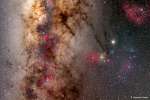 A Scorpius Sky Spectacular
4.05.2014
If Scorpius looked this good to the unaided eye, humans might remember it better. Scorpius more typically appears as a few bright stars in a well-known but rarely pointed out zodiacal constellation. To get a spectacular image like this, though, one needs a good camera, color filters, and a digital image processor.
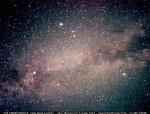 The Milky Way Through the Summer Triangle
12.12.1996
There are more than a few stars in our Galaxy. The light from many of them combines to appear as a wisp of faint light across the night sky - the Milky Way.
|
January February March April May June July August September |
|||||||||||||||||||||||||||||||||||||||||||||||||