
|
You entered: dark
 The Snake Nebula from CFHT
9.04.2002
What slithers overhead? The dark winding lanes visible in part of the constellation of Ophiuchus belong to the Snake Nebula. Also known as Barnard 72, the Snake Nebula is a series of dark absorption clouds made up of molecular gas and interstellar dust.
 Shadow Play
9.09.2006
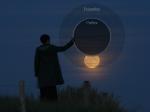
During September 7th's lunar eclipse, the Moon slid through the Earth's shadow. Extending into space, Earth's cone-shaped shadow has two distinct parts, the lighter, outer part or penumbra, and the darker, inner shadow called the umbra. For this eclipse, the lunar disk just grazed the shadow's dark inner umbra.
 A Rainbow Pileus Cloud over Zimbabwe
19.02.2014
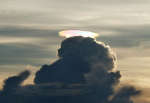
Yes, but how many dark clouds have a multicolored lining? Pictured, behind this darker cloud, is a pileus iridescent cloud, a group of water droplets that have a uniformly similar size and so together diffract different colors of sunlight by different amounts.
 Diamonds in the Sky
20.04.2024
When the dark shadow of the Moon raced across North America on April 8, sky watchers along the shadow's narrow central path were treated to a total solar eclipse. During the New Moon's shadow play diamonds glistened twice in the eclipse-darkened skies.
 2001: A Total Lunar Eclipse
18.01.2001
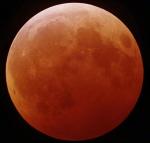
The first and only total lunar eclipse for the year 2001 occured on the evening of January 9/10 as the full Moon glided through Earth's shadow. Unlike a total solar eclipse, a total lunar eclipse is visible for anyone on the night side of the planet during the event.
 M7: Open Star Cluster in Scorpius
8.11.2009
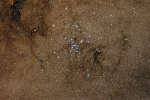
M7 is one of the most prominent open clusters of stars on the sky. The cluster, dominated by bright blue stars, can be seen with the naked eye in a dark sky in the tail of the constellation of the Scorpion (Scorpius).
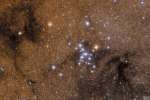 M7: Open Star Cluster in Scorpius
7.01.2014
M7 is one of the most prominent open clusters of stars on the sky. The cluster, dominated by bright blue stars, can be seen with the naked eye in a dark sky in the tail of the constellation of the Scorpion (Scorpius).
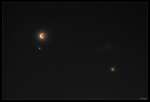 Spica, Mars, and Eclipsed Moon
16.04.2014
A beautiful, reddened Moon slid through dark skies on April 15, completely immersed in Earth's shadow for well over an hour. It was the year's first total lunar eclipse and was widely enjoyed over the planet's Western Hemisphere.
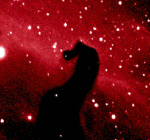 A Close-Up of the Horsehead Nebula
5.10.1996
1500 light years away lies a nebula of quite peculiar shape. How did the dark dust cloud shown above come to be shaped like a horse's head? Nobody knows! Barnard 33, as this...
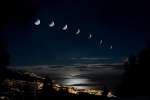 Eclipse at Moonset
29.12.2010
Hugging the horizon, a dark red Moon greeted early morning skygazers in eastern Atlantic regions on December 21, as the total phase of 2010's Solstice Lunar Eclipse began near moonset. This well composed...
|
January February March April May June July August September |
|||||||||||||||||||||||||||||||||||||||||||||||||