
|
You entered: emission
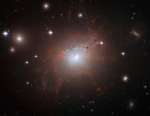 Active Galaxy NGC 1275
22.08.2008
Active galaxy NGC 1275 is the central, dominant member of the large and relatively nearby Perseus Cluster of Galaxies. A prodigious source of x-rays and radio emission, NGC 1275 accretes matter as entire galaxies fall into it, ultimately feeding a supermassive black hole at the galaxy's core.
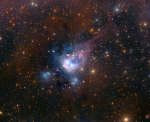 Young Suns of NGC 7129
29.08.2016
Young suns still lie within dusty NGC 7129, some 3,000 light-years away toward the royal constellation Cepheus. While these stars are at a relatively tender age, only a few million years old, it is likely that our own Sun formed in a similar stellar nursery some five billion years ago.
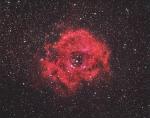 The Rosette Nebula
14.02.1998
Would the Rosette Nebula by any other name look as sweet? The bland New General Catalog designation of NGC 2237 doesn't appear to diminish the appearance of the this flowery emission nebula. Inside the nebula lies an open cluster of bright young stars designated NGC 2244.
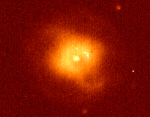 NGC 4361: Galaxy Shaped Planetary Nebula
29.12.1995
Glowing in the red light emitted by hydrogen atoms, the planetary nebula NGC 4361 is pictured above. The nebula itself is formed by the outer layers of gas shrugged off by the central star visible in the image.
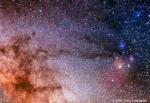 The Pipe Dark Nebula
26.05.2002
The dark nebula predominant at the lower left of the above photograph is known as the Pipe Nebula. The dark clouds, suggestively shaped like smoke rising from a pipe, are caused by absorption of background starlight by dust.
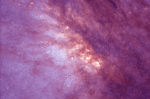 Central Galactic Star Bursts
1.10.1995
The pictured core of the galaxy NGC 253 shows an exceptionally high rate of star formation. In the center are some of the densest knots of stars ever found, surrounded by glowing gas and dust lanes. Galaxies where such high star formation rates are seen are called "starburst" galaxies.
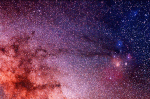 The Pipe Dark Nebula
28.05.1996
The dark nebula predominant at the lower left of the above photograph is known as the Pipe Nebula. The dark clouds, suggestively shaped like smoke rising from a pipe, are caused by absorption of background starlight by dust.
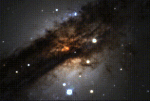 Dusty Galaxy Centaurus A
30.03.1997
One of the most unusual galaxies known, Centaurus A, is pictured above. Cen A is marked by dramatic dust lanes that run across the galaxy's center. These dust lanes are so thick they almost completely obscure the galaxy's center in visible light.
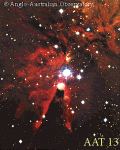 A Mysterious Cone Nebula
1.03.1996
Sometimes the simplest shapes are the hardest to explain. For example, the origin of the mysterious cone-shaped region located just below the center of the above picture remains a mystery. The dark region clearly contains much dust which blocks light from the emission nebula and open cluster NGC 2264 behind it.
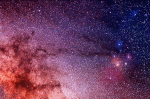 The Pipe Dark Nebula
21.06.1997
The dark nebula predominant at the lower left of the above photograph is known as the Pipe Nebula. The dark clouds, suggestively shaped like smoke rising from a pipe, are caused by absorption of background starlight by dust.
|
January February March April May June July August September |
|||||||||||||||||||||||||||||||||||||||||||||||||