
|
You entered: emission
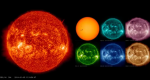 The Sun Rotating
12.03.2014
Does the Sun change as it rotates? Yes, and the changes can vary from subtle to dramatic. In the above time-lapse sequences, our Sun -- as imaged by NASA's Solar Dynamics Observatory -- is shown rotating though the entire month of January.
 APOD: 2020 August 19 Б The Sun Rotating
19.08.2020
Does the Sun change as it rotates? Yes, and the changes can vary from subtle to dramatic. In the featured time-lapse sequences, our Sun -- as imaged by NASA's Solar Dynamics Observatory -- is shown rotating though an entire month in 2014.
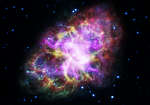 The Multiwavelength Crab
11.05.2017
The Crab Nebula is cataloged as M1, the first object on Charles Messier's famous list of things which are not comets. In fact, the Crab is now known to be a supernova remnant, expanding debris from massive star's death explosion, witnessed on planet Earth in 1054 AD.
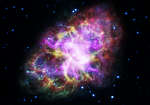 The Multiwavelength Crab
4.03.2022
The Crab Nebula is cataloged as M1, the first object on Charles Messier's famous list of things which are not comets. In fact, the Crab is now known to be a supernova remnant, expanding debris from massive star's death explosion, witnessed on planet Earth in 1054 AD.
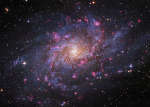 The Hydrogen Clouds of M33
3.10.2019
Gorgeous spiral galaxy M33 seems to have more than its fair share of glowing hydrogen gas. A prominent member of the local group of galaxies, M33 is also known as the Triangulum Galaxy and lies a mere 3 million light-years away.
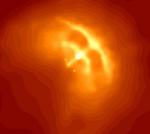 Vela Pulsar: Neutron Star-Ring-Jet
9.06.2000
This stunning image from the orbiting Chandra X-ray Observatory is centered on the Vela pulsar -- the collapsed stellar core within the Vela supernova remnant some 800 light-years distant. The Vela pulsar is a neutron star. More massive than the Sun, it has the
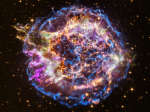 Recycling Cassiopeia A
6.09.2019
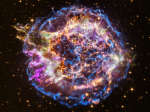
Massive stars in our Milky Way Galaxy live spectacular lives. Collapsing from vast cosmic clouds, their nuclear furnaces ignite and create heavy elements in their cores. After a few million years, the enriched material is blasted back into interstellar space where star formation can begin anew.
 Recycling Cassiopeia A
23.01.2021
Massive stars in our Milky Way Galaxy live spectacular lives. Collapsing from vast cosmic clouds, their nuclear furnaces ignite and create heavy elements in their cores. After a few million years, the enriched material is blasted back into interstellar space where star formation can begin anew.
 Recycling Cassiopeia A
1.06.2023
Massive stars in our Milky Way Galaxy live spectacular lives. Collapsing from vast cosmic clouds, their nuclear furnaces ignite and create heavy elements in their cores. After a few million years, the enriched material is blasted back into interstellar space where star formation can begin anew.
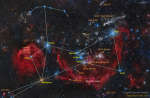 Official Star Names for Orion
4.12.2016
Familiar stars in Orion and constellations across the sky now have official names. Over the past year, the International Astronomical Union, the only body officially tasked with naming stars, approved names already in common use for 227 of the brightest stars, including the most famous stars on the sky Sirius, Polaris, and Betelgeuse.
|
January February March April May June July August September |
|||||||||||||||||||||||||||||||||||||||||||||||||