
|
You entered: emission
 The Hydrogen Clouds of M33
30.09.2021
Gorgeous spiral galaxy M33 seems to have more than its fair share of glowing hydrogen gas. A prominent member of the local group of galaxies, M33 is also known as the Triangulum Galaxy and lies a mere 3 million light-years away.
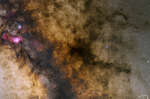 The Central Milky Way from Lagoon to Pipe
1.10.2021
Dark markings and colorful clouds inhabit this stellar landscape. The deep and expansive view spans more than 30 full moons across crowded star fields toward the center of our Milky Way Galaxy. Cataloged in the early 20th century by astronomer E. E.
 APOD: 2025 January 29 Б Dust Shells around WR 140 from Webb
29.01.2025
What are those strange rings? Rich in dust, the rings are likely 3D shells -- but how they were created remains a topic of research. Where they were created is well known: in a binary...
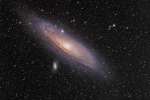 Andromeda Island Universe
9.01.2010
The most distant object easily visible to the eye is M31, the great Andromeda Galaxy some two and a half million light-years away. But without a telescope, even this immense spiral galaxy - spanning over 200,000 light years - appears as a faint, nebulous cloud in the constellation Andromeda.
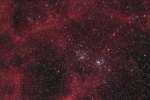 Double Cluster in Perseus
23.01.2014
This lovely starfield spans some seven full moons (about 3.5 degrees) across the heroic northern constellation of Perseus. Just right of center it holds the famous pair of open or galactic star clusters, h and Chi Perseii.
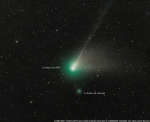 ZTF meets ATLAS
10.02.2023
Fading as it races across planet Earth's northern skies comet C/2022 E3 (ZTF) shares this telescopic frame with comet C/2022 U2 (ATLAS). Captured on the night of February 6 from a garden observatory in Germany's Bavarian Forest, the starry field of view toward the constellation Auriga spans about 2.5 degrees.
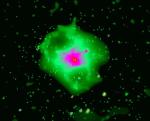 X rays From HCG 62
9.03.2001
Scanning the skies for galaxies Canadian astronomer Paul Hickson and colleagues identified some 100 compact groups of galaxies, now appropriately called Hickson Compact Groups (HCGs). With only a few member galaxies per group, HCGs...
 APOD: 2025 July 16 Б The Rosette Nebula from DECam
16.07.2025
Would the Rosette Nebula by any other name look as sweet? The bland New General Catalog designation of NGC 2237 doesn't appear to diminish the appearance of this flowery emission nebula, as captured by the Dark Energy Camera (DECam) on the Blanco 4-meter telescope at the NSF's Cerro Tololo Inter-American Observatory in Chile.
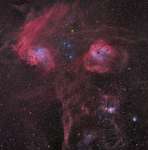 Aurigae Nebulae
24.02.2012
Rich in star clusters and nebulae, the ancient constellation of Auriga, the Charioteer, rides high in northern winter night skies. Composed from narrow and broadband filter data and spanning nearly 8 Full Moons (4 degrees) on the sky, this deep telescopic view recorded in January shows off some of Auriga's celestial bounty.
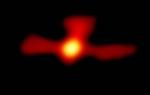 A Galactic Cloud of Antimatter
1.05.1997
The center of our Milky Way Galaxy is full of surprises. Its latest spectacular is a mysterious cloud glowing in gamma rays produced by annihilating antimatter particles! Star Trek fans are all too familiar...
|
January February March April May June July August September |
|||||||||||||||||||||||||||||||||||||||||||||||||