
|
You entered: emission
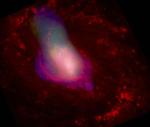 NGC 1068 and the X Ray Flashlight
11.07.2003
At night, tilting a flashlight up under your chin hides the glowing bulb from the direct view of your friends. Light from the bulb still reflects from your face though, and can give you a startling appearance.
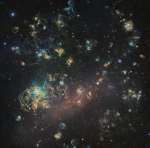 Clouds of the Large Magellanic Cloud
3.05.2019
The Large Magellanic Cloud (LMC) is an alluring sight in southern skies. But this deep and detailed telescopic view, over 10 months in the making, goes beyond what is visible to most circumnavigators of planet Earth.
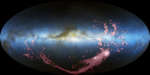 The Magellanic Stream
25.01.2010
Spanning the sky toward the majestic Clouds of Magellan is an unusual stream of gas: the Magellanic Stream. The origin of this gas remains unknown but likely hold a clue to origin and fate of our Milky Way's most famous satellite galaxies: the LMC and the SMC.
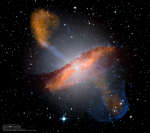 Centaurus As Warped Magnetic Fields
21.04.2021
When galaxies collide -- what happens to their magnetic fields? To help find out, NASA pointed SOFIA, its flying 747, at galactic neighbor Centaurus A to observe the emission of polarized dust -- which traces magnetic fields.
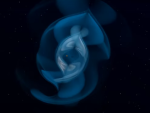 GW200115: Simulation of a Black Hole Merging with a Neutron Star
14.07.2021
What happens when a black hole destroys a neutron star? Analyses indicate that just such an event created gravitational wave event GW200115, detected in 2020 January by LIGO and Virgo observatories. To better understand the unusual event, the featured visualization was created from a computer simulation.
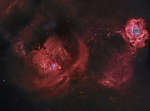 Field of Rosette
14.02.2010
What surrounds the florid Rosette nebula? To better picture this area of the sky, the famous flowery emission nebula on the far right has been captured recently in a deep and dramatic wide field image that features several other sky highlights.
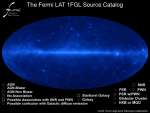 Fermi Catalogs the Gamma ray Sky
18.03.2010
What shines in the gamma-ray sky? The most complete answer yet to that question is offered by the Fermi Gamma-ray Space Telescope's first all-sky catalog. Fermi's sources of cosmic gamma-rays feature nature...
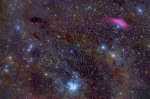 Comet PanSTARRS is near the Edge
16.02.2018
The comet PanSTARRS, also known as the blue comet (C/2016 R2), really is near the lower left edge of this stunning, wide field view recorded on January 13. Spanning nearly 20 degrees on the sky, the cosmic landscape is explored by well-exposed and processed frames from a sensitive digital camera.
 A Gegenschein Lunar Eclipse
14.10.2015
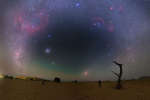
Is there anything interesting to see in the direction opposite the Sun? One night last month, there were quite a few things. First, the red-glowing orb on the lower right of the featured image is the full moon, darkened and reddened because it has entered Earth's shadow.
 The Perseus Cluster s X Ray Skull
31.10.2000
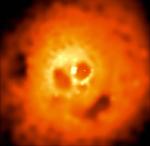
This haunting image from the orbiting Chandra Observatory reveals the Perseus Cluster of Galaxies in x-rays, photons with a thousand or more times the energy of visible light. Three hundred twenty million light-years distant, the Perseus Cluster contains thousands of galaxies, but none of them are seen here.
|
January February March April May June July August September |
|||||||||||||||||||||||||||||||||||||||||||||||||