
|
You entered: radio
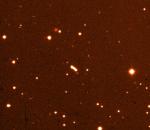 Asteroid 2002 NY40
17.08.2002
Asteroid 2002 NY40 will fly by planet Earth early in the morning August 18 Universal Time (late in the evening August 17 Eastern Daylight Time). Approaching to within about 530,000 kilometers or 1.3 times the Earth-Moon distance 2002 NY40 will definitely not be close enough to pose any danger of collision.
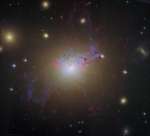 Hubble Remix: Active Galaxy NGC 1275
4.06.2010
Active galaxy NGC 1275 is the central, dominant member of the large and relatively nearby Perseus Cluster of Galaxies. Wild-looking at visible wavelengths, the active galaxy is also a prodigious source of x-rays and radio emission.
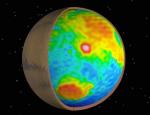 Inside Mars
23.03.2000
What's inside Mars? From orbit, the Mars Global Surveyor (MGS) spacecraft has recorded detailed images of the red planet since July 1997. Still, its cameras can not look beneath the surface. But minute...
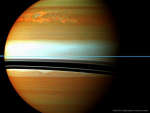 A Long Storm System on Saturn
15.09.2019
It was one of the largest and longest lived storms ever recorded in our Solar System. First seen in late 2010, the above cloud formation in the northern hemisphere of Saturn started larger than the Earth and soon spread completely around the planet.
 APOD: 2023 September 13 Б NGC 4632: Galaxy with a Hidden Polar Ring
13.09.2023
Galaxy NGC 4632 hides a secret from optical telescopes. It is surrounded by a ring of cool hydrogen gas orbiting at 90 degrees to its spiral disk. Such polar ring galaxies have previously been discovered using starlight. However, NGC 4632 is among the first in which a radio telescope survey revealed a polar ring.
 Four X-class Flares
16.05.2013
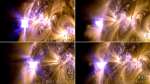
Swinging around the Sun's eastern limb on Monday, a group of sunspots labeled active region AR1748 has produced the first four X-class solar flares of 2013 in less than 48 hours. In time sequence clockwise from the top left, flashes from the four were captured in extreme ultraviolet images from the Solar Dynamics Observatory.
 M31 versus M33
26.09.2015
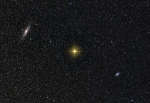
Separated by about 14 degrees (28 Full Moons) in planet Earth's sky, spiral galaxies M31 at left, and M33 are both large members of the Local Group, along with our own Milky Way galaxy.
 The Colorful Clouds of Rho Ophiuchi
14.10.2020
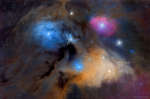
The many spectacular colors of the Rho Ophiuchi (oh'-fee-yu-kee) clouds highlight the many processes that occur there. The blue regions shine primarily by reflected light. Blue light from the Rho Ophiuchi star system and nearby stars reflects more efficiently off this portion of the nebula than red light.
 Venus: Earth's Cloudy Twin
23.09.1996
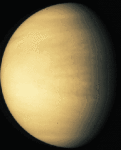
If Venus weren't so cloudy it would be more similar to Earth. This picture by the Galileo spacecraft shows just how cloudy Venus is. Venus is very similar to Earth in size and mass - and so is sometimes referred to as Earth's sister planet - but Venus has a quite different climate.
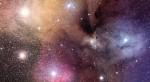 The Colorful Clouds of Rho Ophiuchi
9.07.2005
The many spectacular colors of the Rho Ophiuchi (oh'-fee-yu-kee) clouds highlight the many processes that occur there. The blue regions shine primarily by reflected light. Blue light from the star Rho Ophiuchi and nearby stars reflects more efficiently off this portion of the nebula than red light.
|
January February March April May June July August September October |
|||||||||||||||||||||||||||||||||||||||||||||||||