
|
You entered: radio
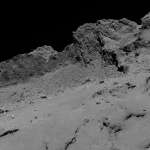 Rosetta s Farewell
1.10.2016
After closely following comet 67P/Churyumov-Gerasimenko for 786 days as it rounded the Sun, the Rosetta spacecraft's controlled impact with the comet's surface was confirmed by the loss of signal from the spacecraft on September 30, 2016.
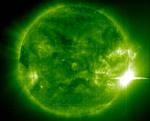 Flare Well AR 10486
6.11.2003
Almost out of view from our fair planet, rotating around the Sun's western edge, giant sunspot region AR 10486 lashed out with another intense solar flare followed by a large coronal mass ejection (CME) on Tuesday, November 4th at about 1950 Universal Time.
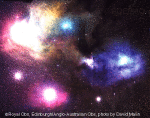 The Colorful Clouds of Rho Ophiuchi
12.03.1996
The many spectacular colors of the Rho Ophiuchi (oh'-fee-yu-kee) clouds highlight the many processes that occur there. The blue regions shine primarily by reflected light. Blue light from the star rho Ophiuchi and nearby stars reflects more efficiently off this portion of the nebula than red light.
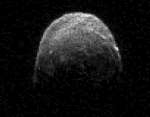 Asteroid 2005 YU55 Passes the Earth
9.11.2011
Asteroid 2005 YU55 passed by the Earth yesterday, posing no danger. The space rock, estimated to be about 400 meters across, coasted by just inside the orbit of Earth's Moon. Although the passing...
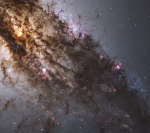 Across the Center of Centaurus A
29.11.2011
A fantastic jumble of young blue star clusters, gigantic glowing gas clouds, and imposing dark dust lanes surrounds the central region of the active galaxy Centaurus A. This image from the Hubble Space Telescope has been processed to present a natural color picture of this cosmic maelstrom.
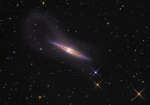 NGC 4013 and the Tidal Stream
7.02.2008
Nearly 50 million light-years away in the constellation Ursa Major, NGC 4013 was long considered an isolated island universe. Seen edge-on, the gorgeous spiral galaxy was known for its flattened disk and central bulge of stars, cut by silhouetted dust lanes.
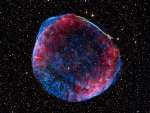 SN 1006 Supernova Remnant
12.07.2014
A new star, likely the brightest supernova in recorded human history, lit up planet Earth's sky in the year 1006 AD. The expanding debris cloud from the stellar explosion, found in the southerly constellation of Lupus, still puts on a cosmic light show across the electromagnetic spectrum.
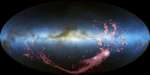 The Magellanic Stream
15.08.2013
In an astronomical version of the search for the source of the Nile, astronomers now have strong evidence for the origin of the Magellanic Stream. This composite image shows the long ribbon...
 APOD: 2023 June 29 Б A Message from the Gravitational Universe
29.06.2023
Monitoring 68 pulsars with very large radio telescopes, the North American Nanohertz Observatory for Gravitational Waves (NANOGrav) has uncovered evidence for the gravitational wave (GW) background by carefully measuring slight shifts in the arrival times of pulses. These shifts are correlated between different pulsars in a way that indicates that they are caused by GWs.
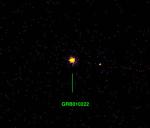 GRB010222: Gamma Ray Burst, X Ray Afterglow
13.04.2001
A fading afterglow from one of the most powerful explosions in the universe is centered in this false color image from the spacebased Chandra X-ray Observatory. The cosmic explosion, an enormously bright gamma-ray burst (GRB), originated in a galaxy billions of light-years away and was detected by the BeppoSAX satellite on February 22.
|
January February March April May June July August September October |
|||||||||||||||||||||||||||||||||||||||||||||||||