
|
You entered: clouds
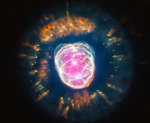 The Eskimo Nebula from Hubble and Chandra
30.07.2013
In 1787, astronomer William Herschel discovered the Eskimo Nebula. From the ground, NGC 2392 resembles a person's head surrounded by a parka hood. In 2000, the Hubble Space Telescope imaged the Eskimo Nebula in visible light, while the nebula was imaged in X-rays by the Chandra X-ray Observatory in 2007.
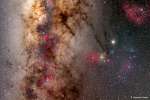 A Scorpius Sky Spectacular
4.05.2014
If Scorpius looked this good to the unaided eye, humans might remember it better. Scorpius more typically appears as a few bright stars in a well-known but rarely pointed out zodiacal constellation. To get a spectacular image like this, though, one needs a good camera, color filters, and a digital image processor.
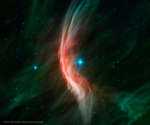 Zeta Oph: Runaway Star
5.07.2015
Like a ship plowing through cosmic seas, runaway star Zeta Ophiuchi produces the arcing interstellar bow wave or bow shock seen in this stunning infrared portrait. In the false-color view, bluish Zeta...
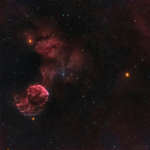 The Jellyfish and Mars
19.05.2021
Normally faint and elusive, the Jellyfish Nebula is caught in this alluring scene. In the telescopic field of view two bright yellowish stars, Mu and Eta Geminorum, stand just below and above the Jellyfish Nebula at the left. Cool red giants, they lie at the foot of the celestial twin.
 NGC 2403 in Camelopardalis
3.06.2024
Magnificent island universe NGC 2403 stands within the boundaries of the long-necked constellation Camelopardalis. Some 10 million light-years distant and about 50,000 light-years across, the spiral galaxy also seems to have more than its fair share of giant star forming HII regions, marked by the telltale reddish glow of atomic hydrogen gas.
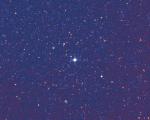 A Close Encounter Of The Stellar Kind
7.07.2001
The unassuming star centered in this sky view will one day be our next door stellar neighbor. The faint 9th magnitude red dwarf, currently 63 light-years away in the constellation Ophiucus, was recently discovered to be approaching our Solar System.
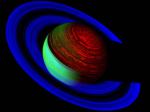 Neon Saturn
27.06.2007
If seen in the right light, Saturn glows like a neon sign. Although Saturn has comparatively little of the element neon, a composite image false-colored in three bands of infrared light highlights features of the giant ringed planet like a glowing sign.
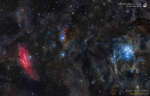 From California to the Pleiades
22.11.2013
An astronomical trip from the California Nebula to the Pleiades star cluster would cover just 12 degrees across planet Earth's night sky. That's equivalent to the angular extent of 25 Full Moons, as your telescope sweeps over the borders of the constellations Perseus and Taurus.
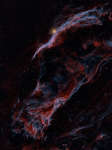 Along the Western Veil
19.09.2019
Delicate in appearance, these filaments of shocked, glowing gas, are draped across planet Earth's sky toward the constellation of Cygnus. They form the western part of the Veil Nebula. The Veil Nebula itself is a large supernova remnant, an expanding cloud born of the death explosion of a massive star.
 Temperatures on Exoplanet WASP 43b
3.05.2024
A mere 280 light-years from Earth, tidally locked, Jupiter-sized exoplanet WASP-43b orbits its parent star once every 0.8 Earth days. That puts it about 2 million kilometers (less than 1/25th the orbital distance of Mercury) from a small, cool sun.
|
January February March April May June July August September October |
|||||||||||||||||||||||||||||||||||||||||||||||||