
|
You entered: clouds
 APOD: 2025 June 4 Б A Milky Road to the Rubin Observatory
3.06.2025
Is the sky the same every night? No -- the night sky changes every night in many ways. To better explore how the night sky changes, the USA's NSF and DOE commissioned the Vera C. Rubin Observatory in Cerro PachцЁn, Chile.
 Recycling Columbia
14.11.2001
Twenty years ago this week, the Space Shuttle Columbia became the first reusable spaceship. Its second trip to low Earth orbit and back again began on November 12, 1981, following its maiden voyage by only seven months.
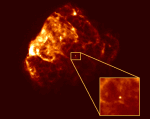 Supernova Remnant and Neutron Star
13.11.1996
A massive star ends life as a supernova, blasting its outer layers back to interstellar space. The spectacular death explosion is initiated by the collapse of what has become an impossibly dense stellar core. However, this core is not necessarily destroyed.
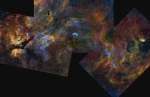 Cygnus Trio
6.11.2008
In this colorful mosaic, filaments of gas and dust span some 9 degrees across central Cygnus, a nebula rich constellation along the northern Milky Way. A trio of nebulae with popular names highlights the beautiful skyscape - the Butterfly, the Crescent, and the Tulip.
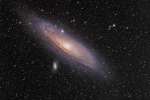 Andromeda Island Universe
8.01.2010
The most distant object easily visible to the eye is M31, the great Andromeda Galaxy some two and a half million light-years away. But without a telescope, even this immense spiral galaxy - spanning over 200,000 light years - appears as a faint, nebulous cloud in the constellation Andromeda.
 APOD: 2023 April 2 Б M57: The Ring Nebula from Hubble
1.04.2023
It was noticed hundreds of years ago by stargazers who could not understand its unusual shape. It looked like a ring on the sky. Except for the rings of Saturn, the Ring Nebula (M57) may be the most famous celestial circle.
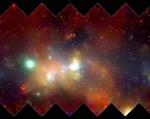 X Ray Milky Way
12.07.2003
If you had x-ray vision, the center regions of our Galaxy would not be hidden from view by the immense cosmic dust clouds opaque to visible light. Instead, the Milky Way toward Sagittarius might look something like this stunning mosaic of images from the orbiting Chandra Observatory.
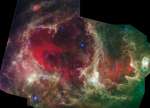 Generations of Stars in W5
29.08.2008
Giant star forming region W5 is over 200 light-years across and about 6,500 light-years away in the constellation Cassiopeia. W5's sculpted clouds of cold gas and dust seem to form fantastic shapes in this impressive mosaic of infrared images from the Spitzer Space Telescope.
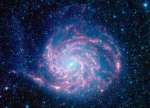 Spitzer s M101
29.12.2009
Big, beautiful spiral galaxy M101 is one of the last entries in Charles Messier's famous catalog, but definitely not one of the least. About 170,000 light-years across, this galaxy is enormous, almost twice the size of our own Milky Way Galaxy.
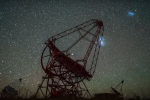 HESS Telescopes Explore the High Energy Sky
7.01.2019
They may look like modern mechanical dinosaurs but they are enormous swiveling eyes that watch the sky. The High Energy Stereoscopic System (H.E.S.S.) Observatory is composed of four 12-meter reflecting-mirror telescopes surrounding a larger telescope housing a 28-meter mirror.
|
January February March April May June July August September October |
|||||||||||||||||||||||||||||||||||||||||||||||||