
|
You entered: Sun
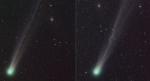 Comet C 2001 Q4 (NEAT)
23.04.2004
Inbound from the distant solar system, comet C/2001 Q4 will soon pass just inside planet Earth's orbit and should be one of two bright, naked-eye comets visible in southern skies in May. First...
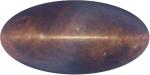 The Far Infrared Sky
17.05.2000
Three major sources contribute to the far-infrared sky: our Solar System, our Galaxy, and our Universe. The above recently released image, in representative colors, is the highest resolution projection yet created of the entire far-infrared sky (60 - 240 microns) created from years of observations by the now-defunct robot spacecraft COBE.
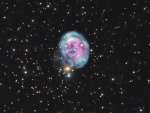 NGC 7008: The Fetus Nebula
25.08.2008
Compact and round, NGC 7008 is recognized as a planetary nebula about 2,800 light-years distant in the nebula rich constellation of Cygnus. This impressive telescopic view shows off NGC 7008's remarkable colors...
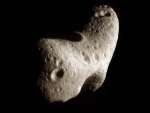 Asteroid Eros Reconstructed
7.06.2009
Orbiting the Sun between Mars and Earth, asteroid 433 Eros was visited by the robot spacecraft NEAR-Shoemaker in 2000 February. High-resolution surface images and measurements made by NEAR's Laser Rangefinder (NLR) have been combined into the above visualization based on the derived 3D model of the tumbling space rock.
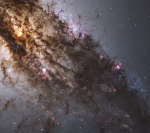 Across the Center of Centaurus A
29.11.2011
A fantastic jumble of young blue star clusters, gigantic glowing gas clouds, and imposing dark dust lanes surrounds the central region of the active galaxy Centaurus A. This image from the Hubble Space Telescope has been processed to present a natural color picture of this cosmic maelstrom.
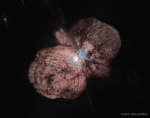 Doomed Star Eta Carinae
27.12.2015
Eta Carinae may be about to explode. But no one knows when - it may be next year, it may be one million years from now. Eta Carinae's mass - about 100 times greater than our Sun - makes it an excellent candidate for a full blown supernova.
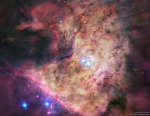 Trapezium: At the Heart of Orion
5.08.2018
Near the center of this sharp cosmic portrait, at the heart of the Orion Nebula, are four hot, massive stars known as the Trapezium. Gathered within a region about 1.5 light-years in radius, they dominate the core of the dense Orion Nebula Star Cluster.
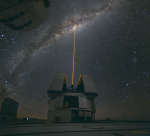 A Laser Strike at the Galactic Center
6.01.2019
Why are these people shooting a powerful laser into the center of our Galaxy? Fortunately, this is not meant to be the first step in a Galactic war. Rather, astronomers at the Very Large Telescope (VLT) site in Chile are trying to measure the distortions of Earth's ever changing atmosphere.
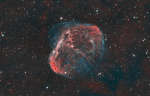 NGC 6888: The Crescent Nebula
17.06.2021
NGC 6888, also known as the Crescent Nebula, is a about 25 light-years across blown by winds from its central, bright, massive star. A triumvirate of astroimagers ( Joe, Glenn, Russell) created this sharp portrait of the cosmic bubble.
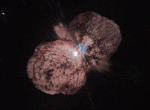 Doomed Star Eta Carinae
12.07.1997
Eta Carinae may be about to explode. But no one knows when - it may be next year, it may be one million years from now. Eta Carinae's mass - about 100 times greater than our Sun - make it an excellent candidate for a full blown supernova.
|
January February March April May June July August September October |
|||||||||||||||||||||||||||||||||||||||||||||||||