
|
You entered: Sun
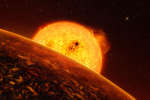 CoRoT Satellite Discovers Rocky Planet
23.09.2009
How similar is exoplanet CoRoT-7b to Earth? The newly discovered extra-solar planet is the closest physical match yet, with a mass about five Earths and a radius of about 1.7 Earths. Also, the home star to CoRoT-7b, although 500 light years distant, is very similar to our Sun.
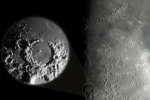 Hesiodus Sunrise Ray
27.03.2010
Stark shadows of mountains and crater walls stand out along the lunar terminator, or shadow line between night and day, in this telescopic image. Of course, if viewed from the lunar surface near the terminator line, the Sun would be rising and still close to the lunar horizon.
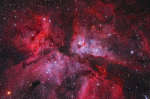 The Great Carina Nebula
15.10.2013
A jewel of the southern sky, the Great Carina Nebula, also known as NGC 3372, spans over 300 light-years, one of our galaxy's largest star forming regions. Like the smaller, more northerly Great...
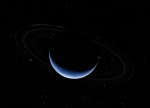 Voyager s Neptune
15.05.2014
Cruising through the outer solar system, the Voyager 2 spacecraft made its closest approach to Neptune on August 25, 1989, the only spacecraft to visit the most distant gas giant. Based on the images...
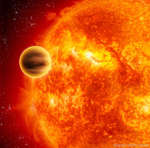 NGST 10b: Discovery of a Doomed Planet
26.02.2020
This hot jupiter is doomed. Hot jupiters are giant planets like Jupiter that orbit much closer to their parent stars than Mercury does to our Sun. But some hot jupiters are more extreme than others. NGTS-10b, illustrated generically, is the closest and fastest-orbiting giant planet yet discovered, circling its home star in only 18 hours.
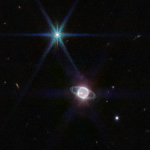 Ringed Ice Giant Neptune
23.09.2022
Ringed, ice giant Neptune lies near the center of this sharp near-infrared image from the James Webb Space Telescope. The dim and distant world is the farthest planet from the Sun, about 30 times farther away than planet Earth.
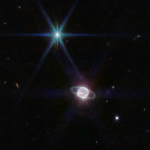 Ringed Ice Giant Neptune
19.08.2023
Ringed ice giant Neptune lies near the center of this sharp near-infrared image from the James Webb Space Telescope. The dim and distant world is the farthest planet from the Sun, about 30 times farther away than planet Earth.
 Encke and the Tadpoles
27.10.2023
History's second known periodic comet is Comet Encke (2P/Encke). As it swings through the inner Solar System, Encke's orbit takes it from an aphelion, its greatest distance from the Sun, inside the orbit of Jupiter to a perihelion just inside the orbit of Mercury.
 APOD: 2024 April 1 Б Swirling Magnetic Field around Our Galaxys Central Black Hole
1.04.2024
What's happening to the big black hole in the center of our galaxy? It is sucking in matter from a swirling disk -- a disk that is magnetized, it has now been confirmed. Specifically, the black hole's accretion disk has recently been seen to emit polarized light, radiation frequently associated with a magnetized source.
 Ringed Ice Giant Neptune
6.09.2024
Ringed ice giant Neptune lies near the center of this sharp near-infrared image from the James Webb Space Telescope. The dim and distant world is the farthest planet from the Sun, about 30 times farther away than planet Earth.
|
January February March April May June July August September October |
|||||||||||||||||||||||||||||||||||||||||||||||||