
|
You entered: distance
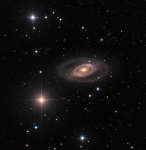 Spiral Galaxy NGC 1350
12.02.2021
This gorgeous island universe lies about 85 million light-years distant in the southern constellation Fornax. Inhabited by young blue star clusters, the tightly wound spiral arms of NGC 1350 seem to join in a circle around the galaxy's large, bright nucleus, giving it the appearance of a cosmic eye.
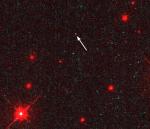 A Lonely Neutron Star
28.11.1998
How massive can a star get without imploding into a black hole? These limits are being tested by the discovery of a lone neutron star in space. Observations by the Hubble Space Telescope have...
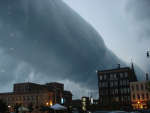 Roll Cloud Over Wisconsin
8.09.2013
What kind of cloud is this? A type of arcus cloud called a roll cloud. These rare long clouds may form near advancing cold fronts. In particular, a downdraft from an advancing storm front can cause moist warm air to rise, cool below its dew point, and so form a cloud.
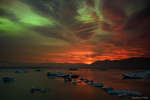 Aurora and Volcanic Light Pillar
23.09.2014
That's no sunset. And that thin red line just above it -- that's not a sun pillar. The red glow on the horizon originates from a volcanic eruption, and the red line is the eruption's reflection from fluttering atmospheric ice crystals. This unusual volcanic light pillar was captured over Iceland earlier this month.
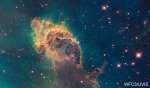 Carina Nebula Dust Pillar
7.02.2015
This cosmic pillar of gas and dust is nearly two light-years wide. The structure lies within one of our galaxy's largest star forming regions, the Carina Nebula, shining in southern skies at a distance of about 7,500 light-years.
 Star Factory Messier 17
8.09.2023
Sculpted by stellar winds and radiation, the star factory known as Messier 17 lies some 5,500 light-years away in the nebula-rich constellation Sagittarius. At that distance, this 1/3 degree wide field of view spans over 30 light-years.
 Zimbabwe Sunset
21.06.2002
Today's scheduled geocentric astronomical event is the Solstice, with the Sun reaching its northernmost declination at 13 hours 24 minutes Universal Time. For denizens of planet Earth this Solstice marks the begining of Summer in the northern hemisphere and Winter in the south.
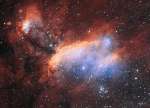 IC 4628: The Prawn Nebula
23.09.2013
South of Antares, in the tail of the nebula-rich constellation Scorpius, lies emission nebula IC 4628. Nearby hot, massive stars, millions of years young, radiate the nebula with invisible ultraviolet light, stripping electrons from atoms. The electrons eventually recombine with the atoms to produce the visible nebular glow, dominated by the red emission of hydrogen.
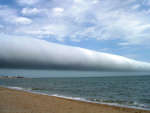 A Roll Cloud Over Uruguay
12.06.2016
What kind of cloud is this? A type of arcus cloud called a roll cloud. These rare long clouds may form near advancing cold fronts. In particular, a downdraft from an advancing storm front can cause moist warm air to rise, cool below its dew point, and so form a cloud.
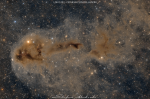 Lynds Dark Nebula 1251
24.11.2022
Stars are forming in Lynds Dark Nebula (LDN) 1251. About 1,000 light-years away and drifting above the plane of our Milky Way galaxy, the dusty molecular cloud is part of a complex of dark nebulae mapped toward the Cepheus flare region.
|
January February March April May June July August September October |
|||||||||||||||||||||||||||||||||||||||||||||||||