
|
You entered: distance
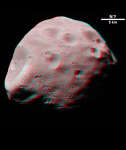 Stereo Phobos
6.08.2022
Get out your red/blue glasses and float next to Phobos, grooved moon of Mars! Captured in 2004 by the High Resolution Stereo Camera on board ESA's Mars Express spacecraft, the image data was recorded at a distance of about 200 kilometers from the martian moon.
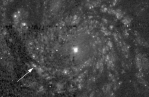 A Supernova in the Whirlpool
21.04.1996
In 1994, a new star in a distant galaxy was seen by amateur astronomers, who alerted the world to their discovery of a supernova. Near the nucleus of spiral galaxy M51, popularly known...
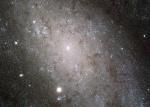 The Stars of NGC 300
16.04.2004
Like grains of sand on a cosmic beach, individual stars of large spiral galaxy NGC 300 are resolved in this sharp image from the Hubble Space Telescope's Advanced Camera for Surveys (ACS).
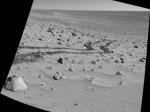 Looking Back Over Mars
15.12.2004
Pictured above, the path of the robot rover Spirit on Mars can be traced far into the distance. Spirit has now crossed kilometers of plains covered with rocks and sand, approached the lip of a crater 200-meters across, and climbed a series of hills.
 Tungurahua Erupts
18.09.2007
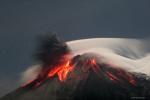
Volcano Tungurahua erupted spectacularly last year. Pictured above, molten rock so hot it glows visibly pours down the sides of the 5,000-meter high Tungurahua, while a cloud of dark ash is seen being ejected toward the left. Wispy white clouds flow around the lava-lit peak, while a star-lit sky shines in the distance.
 Galaxy Cluster Abell 2666
10.03.2017
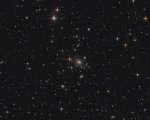
The galaxies of Abell 2666 lie far beyond the Milky Way, some 340 million light-years distant toward the high flying constellation Pegasus. Framed in this sharp telescopic image, the pretty cluster galaxies are gathered behind scattered, spiky, Milky Way stars.
 Sea and Sky Glows over the Oregon Coast
28.08.2018
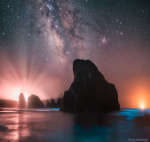
Every step caused the sand to light up blue. That glow was bioluminescence -- a blue radiance that also lights the surf in this surreal scene captured last month at Meyer's Creek Beach in Oregon, USA. Volcanic stacks dot the foreground sea, while a thin fog layer scatters light on the horizon.
 The Stars of NGC 300
20.08.2005
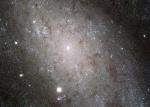
Like grains of sand on a cosmic beach, individual stars of large spiral galaxy NGC 300 are resolved in this sharp image from the Hubble Space Telescope's Advanced Camera for Surveys (ACS). The inner region of the galaxy is pictured, spanning about 7,500 light-years.
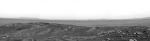 The View from Husband Hill on Mars
7.09.2005
Scroll right to see a breathtaking panorama of Mars from the top of Husband Hill. The image was taken by the robotic rover Spirit now exploring the red planet. Spirit, situated in expansive Gusev Crater, has been exploring the Columbia Hills for some time including climbing Husband Hill over the last few months.
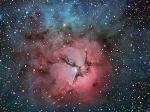 The Trifid Nebula in Stars and Dust
13.08.2007
Unspeakable beauty and unimaginable bedlam can be found together in the Trifid Nebula. Also known as M20, this photogenic nebula is visible with good binoculars towards the constellation of Sagittarius. The energetic processes of star formation create not only the colors but the chaos. The red-glowing gas results from high-energy starlight striking interstellar hydrogen gas.
|
January February March April May June July August September October |
|||||||||||||||||||||||||||||||||||||||||||||||||