
|
You entered: distance
 Comet ISON Before and After
29.11.2013
Sungrazing Comet ISON reached perihelion, its closest approach to the Sun, yesterday, November 28, at 18:45 UT. The comet passed just over 1 million kilometers above the solar surface, a distance less than the diameter of the Sun.
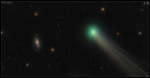 Comet Lovejoy Before Galaxy M63
2.12.2013
Comet Lovejoy was captured last week passing well in front of spiral galaxy M63. Discovered only three months ago and currently near its maximum brightness, Comet Lovejoy can be seen near the Big Dipper from dark northerly locations before dawn with the unaided eye.
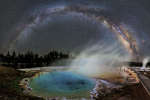 Milky Way over Yellowstone
27.08.2014
The Milky Way was not created by an evaporating lake. The colorful pool of water, about 10 meters across, is known as Silex Spring and is located in Yellowstone National Park in Wyoming, USA. Illuminated artificially, the colors are caused by layers of bacteria that grow in the hot spring.
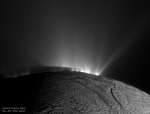 Life Enabling Plumes above Enceladus
15.04.2017
Does Enceladus have underground oceans that could support life? The discovery of jets spewing water vapor and ice was detected by the Saturn-orbiting Cassini spacecraft in 2005. The origin of the water feeding the jets, however, was originally unknown.
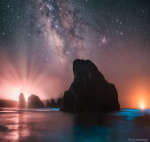 Sea and Sky Glows over the Oregon Coast
3.09.2022
Every step caused the sand to light up blue. That glow was bioluminescence -- a blue radiance that also lights the surf in this surreal scene captured in mid-2018 at Meyer's Creek Beach in Oregon, USA. Volcanic stacks dot the foreground sea, while a thin fog layer scatters light on the horizon.
 Five Meters over Mars
9.08.2023
On mission sol 872 (Earth date August 3) Ingenuity snapped this sharp image on its 54th flight above the surface of the Red Planet. During the flight the Mars Helicopter hovered about 5 meters, or just over 16 feet, above the Jezero crater floor.
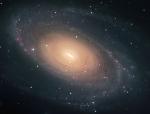 Bright Galaxy M81
20.06.2002
Big and beautiful spiral galaxy M81, in the northern constellation Ursa Major, is one of the brightest galaxies visible in the skies of planet Earth. This superbly detailed view reveals its bright nucleus, grand spiral arms and sweeping cosmic dust lanes with a scale comparable to the Milky Way.
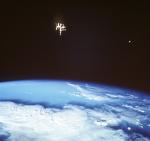 The Moons of Earth
30.04.2005
While orbiting the planet during their June 1998 mission, the crew of the Space Shuttle Discovery photographed this view of two moons of Earth. Thick storm clouds are visible in the lovely blue planet...
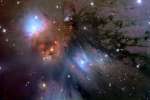 Still Life with NGC 2170
29.12.2010
In this beautiful celestial still life composed with a cosmic brush, dusty nebula NGC 2170 shines at the upper left. Reflecting the light of nearby hot stars, NGC 2170 is joined by other bluish reflection nebulae, a compact red emission region, and streamers of obscuring dust against a backdrop of stars.
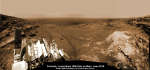 1000 Sols
12.06.2015
Shortly before Mars' June 2015 conjunction, the Curiosity Rover celebrated 1000 sols on the red planet. After its August 5, 2012 landing, Curiosity's 1000th sol or martian day on the surface corresponded to planet Earth's calendar date May 31, 2015.
|
January February March April May June July August September October |
|||||||||||||||||||||||||||||||||||||||||||||||||