
|
You entered: impact
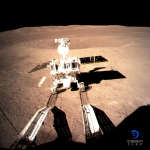 Yutu 2 on the Farside
5.01.2019
On January 3, the Chinese Chang'e-4 spacecraft made the first successful landing on the Moon's farside. Taken by a camera on board the lander, this image is from the landing site inside Von Karman crater.
 APOD: 2023 April 17 Б ELVES Lightning over Italy
17.04.2023
What's that red ring in the sky? Lightning. The most commonly seen type of lightning involves flashes of bright white light between clouds. Over the past 50 years, though, other types of upper-atmospheric lightning have been confirmed, including red sprites and blue jets.
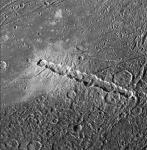 Ganymede: Torn Comet Crater Chain
15.12.2001
This striking line of 13 closely spaced craters on Jupiter's moon Ganymede was photographed by the Galileo spacecraft in 1997. The picture covers an area about 120 miles wide and the chain of craters cuts across a sharp boundary between dark and light terrain. What caused this crater chain?
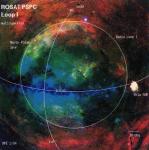 Loop I in the Northern Sky
3.05.1999
One of the largest coherent structures on the sky is known simply as Loop I and can best be seen in radio and X-ray maps. Spanning over 100 degrees, part of Loop I appears so prominent in northern sky maps that it is known as the North Polar Spur (NPS).
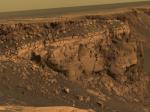 At the Edge of Victoria Crater
3.07.2007
We're going in. The robotic Opportunity rover currently rolling across Mars has been prowling around the edge of the largest crater it has visited since landing over three years ago. It has been studying Victoria crater and looking for a way in.
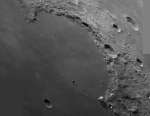 The Bay of Rainbows
8.02.2008
Dark, smooth regions that cover the Moon's familiar face are called by Latin names for oceans and seas. The naming convention is historical, though it may seem a little ironic to denizens...
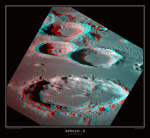 Southwest Mare Fecunditatis
3.03.2018
Frank Borman, James Lovell, and William Anders journeyed from Earth to the Moon and back again in December of 1968. From lunar orbit, their view of craters in southwest Mare Fecunditatis is featured in this stereo anaglyph, best experienced from armchairs on planet Earth with red/blue glasses.
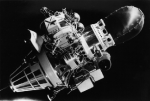 Luna 9: First Soft Lander
25.08.1996
The Luna 9 spacecraft above performed the first soft landing on another planetary body. Following a series of failures, the Soviet probe touched down in the Moon's Oceanus Procellarum region February 3, 1966.
 Odyssey Over Mars
22.03.2002
Scroll right and journey for 300 kilometers over Terra Sirenum in the cratered highlands of southern Mars. The infrared view, 32 kilometers wide, was recently recorded by the THEMIS camera on board the orbiting Mars Odyssey spacecraft.
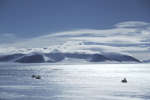 Searching for Meteorites in Antarctica
7.09.2008
Where is the best place on Earth to find meteorites? Although meteors fall all over the world, they usually just sink to the bottom of an ocean, are buried by shifting terrain, or are easily confused with terrestrial rocks.
|
January February March April May June July August September October |
|||||||||||||||||||||||||||||||||||||||||||||||||