
|
You entered: impact
 Apollo 15's Home on the Moon
5.07.1998
Could you ever call this place home? The lunar module shown above, named "Falcon," served as home for Apollo 15 astronauts David Scott and James Irwin during their stay on the Moon in July and August 1971. Meanwhile, astronaut Alfred Worden circled in the command module overhead.
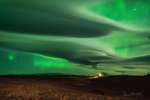 Aurora over Clouds
23.11.2015
Auroras usually occur high above the clouds. The auroral glow is created when fast-moving particles ejected from the Sun impact the Earth's magnetosphere, from which charged particles spiral along the Earth's magnetic field to strike atoms and molecules high in the Earth's atmosphere.
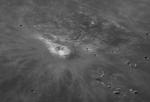 Aristarchus Plateau
29.11.2007
Anchored in the vast lava flows of the Moon's Oceanus Procellarum lies the Aristarchus Plateau. The bright impact crater at the corner of the plateau is Aristarchus, a young crater 42 kilometers wide and 3 kilometers deep. Only slightly smaller, lava flooded Herodotus crater is above and to the left.
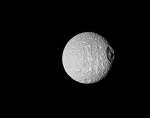 Mimas, Crater, and Mountain
10.01.2017
Mimas is an icy, crater-pocked moon of Saturn a mere 400 kilometers (250 miles) in diameter. Its largest crater Herschel is nearly 140 kilometers wide. About a third the diameter of Mimas itself, Herschel crater gives the small moon an ominous appearance, especially for scifi fans of the Death Star battlestation of Star Wars fame.
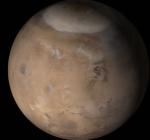 Springtime on Mars
22.04.2003
Vast canyons, towering volcanoes, sprawling fields of ice, deep craters, and high clouds can all be seen in this image of the Solar System's fourth planet: Mars. The orbiting robot Mars Global Surveyor spacecraft took the above mosaic of images as springtime dawned in Northern Mars in 2002 May.
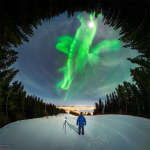 A Whale of an Aurora over Swedish Forest
21.03.2022
What's that in the sky? An aurora. A large coronal mass ejection occurred on our Sun earlier this month, throwing a cloud of fast-moving electrons, protons, and ions toward the Earth. Part...
 APOD: 2024 May 5 Б A Black Hole Disrupts a Passing Star
4.05.2024
What happens to a star that goes near a black hole? If the star directly impacts a massive black hole, then the star falls in completely -- and everything vanishes. More likely, though, the star goes close enough to have the black hole's gravity pull away its outer layers, or disrupt, the star.
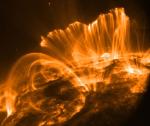 Coronal Rain, Solar Storm
14.11.2000
In this picture, the Sun's surface is quite dark. A frame from a movie recorded on November 9th by the orbiting TRACE telescope, it shows coronal loops lofted over a solar active region.
 Orionids in Taurus
25.10.2023
History's first known periodic comet, Comet Halley (1P/Halley), returns to the inner Solar System every 76 years or so. The famous comet made its last appearance to the naked-eye in 1986. But dusty...
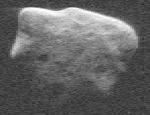 1999 JM8: A Rock Too Close
1.09.1999
Nearly four kilometers across, the huge rock known as 1999 JM8 silently passed only 8.5 million kilometers from the Earth in early August. The small asteroid was completely unknown before May. Every few centuries, a rock like this impacts the Earth, with the potential to disrupt modern civilization.
|
January February March April May June July August September October |
|||||||||||||||||||||||||||||||||||||||||||||||||