
|
You entered: spacecraft
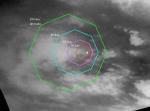 Descent to Titan
14.01.2005
Today's descent to the surface of Titan by the European Space Agency's Huygens probe is the most distant landing ever attempted by a spacecraft from Earth. At 10:13 UT (5:13am...
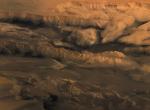 Melas, Candor, and Ophir: Valleys of Mariner
17.02.2005
First imaged by the Mariner 9 spacecraft, Valles Marineris, the grand canyon of Mars, is a system of enormous depressions or chasmas that stretch some 4,000 kilometers along the Martian equator. Looking north over the canyon's central regions, dark Melas Chasma lies in the foreground of this spectacular perspective view.
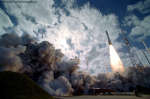 APOD: 2015 July 12 New Horizons Launch to Pluto
12.07.2015
Destination: Pluto. The New Horizons spacecraft roared off its launch pad at Cape Canaveral in Florida, USA in 2006 toward adventures in the distant Solar System. The craft is the fastest spaceships ever launched by humans, having passed the Moon only nine hours after launch, and Jupiter only a year later.
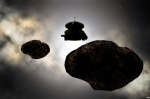 New Horizons at Ultima Thule
29.12.2018
When we celebrate the start of 2019, on January 1 the New Horizons spacecraft will flyby Ultima Thule. A world of the Kuiper belt 6.5 billion kilometers from the Sun, the nickname Ultima Thule (catalog designation 2014 MU69) fittingly means "beyond the known world".
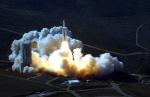 The Last Titan
27.10.2005
On October 19th, a rocket blasted off from Vandengberg Air Force Base - the last Titan rocket. Carrying a payload for the US National Reconnaissance Office, the successful Titan IV B launch brings to a close the Titan program whose first launch was in 1959.
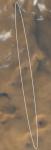 Mars Polar Lander Target Ellipse
4.12.1999
South is up in this recent composite color picture of Mars Polar Lander's target region near the Martian South Pole taken on November 28. Imaged by the orbiting Mars Global Surveyor's wide angle camera, the area covered is 105 kilometers across with the expected landing ellipse superposed.
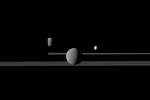 Ringside with Rhea
29.03.2013
Orbiting in the plane of Saturn's rings, Saturnian moons have a perpetual ringside view of the gas giant planet. Of course, while passing near the ring plane the Cassini spacecraft also shares their stunning perspective. The thin rings themselves slice across the middle of this Cassini snapshot from April 2011.
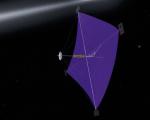 Solar Sail
26.05.2000
Nearly 400 years ago astronomer Johannes Kepler observed comet tails blown by a solar breeze and suggested that vessels might likewise navigate through space using appropriately fashioned sails. It is now widely recognized that...
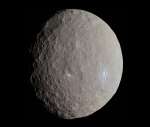 Dwarf Planet Ceres
4.02.2016
Dwarf planet Ceres is the largest object in the Solar System's main asteroid belt, with a diameter of about 950 kilometers (590 miles). Ceres is seen here in approximately true color, based on image data from the Dawn spacecraft recorded on May 4, 2015.
 Orion and the Ocean of Storms
8.12.2022
A camera on board the uncrewed Orion spacecraft captured this view on December 5 as Orion approached its return powered flyby of the Moon. Below one of Orion's extended solar arrays lies dark, smooth, terrain along the western edge of the Oceanus Procellarum.
|
January February March April May June July August September October |
|||||||||||||||||||||||||||||||||||||||||||||||||