
|
You entered: stars
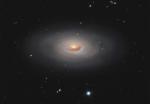 M64: The Black Eye Galaxy
2.08.2007
This bright, beautiful spiral galaxy is Messier 64, sometimes known as the Black Eye Galaxy. M64 lies about 17 million light-years distant in the otherwise well-groomed northern constellation Coma Bernices. The dark clouds along...
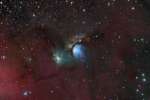 M78 Wide Field
25.11.2009
Interstellar dust clouds and glowing nebulae abound in the fertile constellation of Orion. One of the brightest, M78, is centered in this colorful, wide field view, covering an area north of Orion's belt. At a distance of about 1,500 light-years, the bluish reflection nebula is around 5 light-years across.
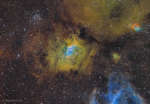 NGC 7635: Bubble in a Cosmic Sea
22.11.2016
Do you see the bubble in the center? Seemingly adrift in a cosmic sea of stars and glowing gas, the delicate, floating apparition in this widefield view is cataloged as NGC 7635 - The Bubble Nebula.
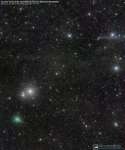 A Conjunction of Comets
22.09.2017
A conjunction of comets is captured in this pretty star field from the morning of September 17. Discovered in July by a robotic sky survey searching for supernovae, comet C/2017 O1 ASASSN is at the lower left. The visible greenish glow of its coma is produced by the fluorescence of diatomic carbon molecules in sunlight.
 A Cosmic Rose: NGC 2237 in Monoceros
13.02.2025
The Rosette Nebula, NGC 2237, is not the only cosmic cloud of gas and dust to evoke the imagery of flowers, but it is probably the most famous. At the edge of a large molecular cloud in Monoceros some 5,000 light years away, the petals of this cosmic rose are actually a stellar nursery.
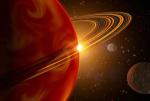 Saturn-Sized Worlds Discovered
30.03.2000
The last decade saw the profound discovery of many worlds beyond our solar system, but none analogs of our home planet Earth. Exploiting precise observational techniques, astronomers inferred the presence of well over two dozen extrasolar planets, most nearly as massive as gas giant Jupiter or more, in close orbits around sun-like stars.
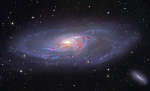 Messier 106
8.04.2021
Close to the Great Bear (Ursa Major) and surrounded by the stars of the Hunting Dogs (Canes Venatici), this celestial wonder was discovered in 1781 by the metric French astronomer Pierre Mechain. Later, it was added to the catalog of his friend and colleague Charles Messier as M106.
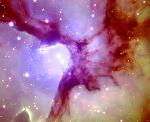 In the Center of the Trifid Nebula
26.06.2002
Clouds of glowing gas mingle with lanes of dark dust in the Trifid Nebula, a star forming region toward the constellation of Sagittarius. In the center, the three huge dark dust lanes that give the Trifid its name all come together.
 Sagittarius and the Central Milky Way
5.06.1996
What does the center of our Milky Way Galaxy look like? No one knows! It is not possible to see the Galactic center in light our eyes are sensitive to because the thick dust in the plane of our Galaxy obscures it.
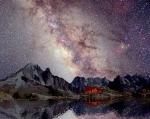 The Milky Way Over Mount Blanc
23.09.2002
Have you ever seen the band of our Milky Way Galaxy? Chances are you have never seen it like this -- nor could you. In a clear sky from a dark location at the right time, a faint band of light is visible across the sky. This band is the disk of our spiral galaxy.
|
January February March April May June July August September October |
|||||||||||||||||||||||||||||||||||||||||||||||||