
|
You entered: stars
 Retrograde Mars
11.05.2008
Why would Mars appear to move backwards? Most of the time, the apparent motion of Mars in Earth's sky is in one direction, slow but steady in front of the far distant stars. About every two years, however, the Earth passes Mars as they orbit around the Sun.
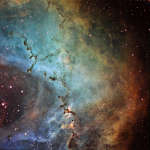 Dust Sculptures in the Rosette Nebula
2.12.2009
What creates the cosmic dust sculptures in the Rosette Nebula? Noted for the common beauty of its overall shape, parts of the Rosette Nebula, also known as NGC 2237, show beauty even when viewed up close.
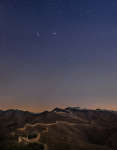 Comet Lovejoy over The Great Wall
20.02.2014
Fading now as it returns to the outer solar system Comet Lovejoy (C/2013 R1) still graces planet Earth's sky, a delicate apparition in binoculars or small telescopes. The comet, a relic...
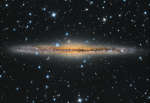 Edge On NGC 891
12.01.2017
Large spiral galaxy NGC 891 spans about 100 thousand light-years and is seen almost exactly edge-on from our perspective. In fact, about 30 million light-years distant in the constellation Andromeda, NGC 891 looks a lot like our Milky Way.
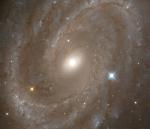 NGC 4603 and the Expanding Universe
27.05.1999
NGC 4603, a galaxy with majestic spiral arms and intricate dust lanes, is 108 million light-years away. Its distance has been accurately measured by astronomers using one of the fundamental yardsticks of the extragalactic distance scale - pulsating variable stars known as Cepheids.
 APOD: 2025 August 24 Б The Spinning Pulsar of the Crab Nebula
24.08.2025
At the core of the Crab Nebula lies a city-sized, magnetized neutron star spinning 30 times a second. Known as the Crab Pulsar, it is the bright spot in the center of the gaseous swirl at the nebula's core.
 A 2000 Leonid Through Orion
20.11.2000
The Leonid Meteor Shower this year could be described as good but not great. During November 17 and 18 the Earth crossed through several streams of sand-sized grit left orbiting the Sun by Comet Tempel-Tuttle. Several distinct peaks in meteor activity were reported, with
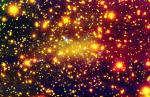 Cepheus 1: Nearby Galaxy Hiding
1.12.1998
Some galaxies are hard to find. Besides being hidden behind the dust and bright foreground stars of our Milky Way Galaxy, recently discovered Cepheus 1 was missed previously because it is so uniformly dim.
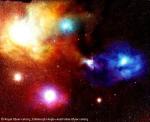 Antares and Rho Ophiuchi
22.09.1997
Why is the sky near Antares and Rho Ophiuchi so colorful? The colors result from a mixture of objects and processes. Fine dust illuminated from the front by starlight produces blue reflection nebulae. Gaseous clouds whose atoms are excited by ultraviolet starlight produce reddish emission nebulae. Backlit dust clouds block starlight and so appear dark.
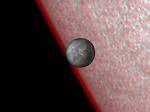 3D Mercury Transit
25.11.2006
Mercury is now visible shortly before dawn, the brightest "star" just above the eastern horizon. But almost two weeks ago Mercury actually crossed the face of the Sun for the second time in the 21st century.
|
January February March April May June July August September October |
|||||||||||||||||||||||||||||||||||||||||||||||||