
|
You entered: cluster gas
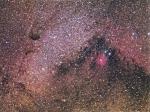 M24: A Sagittarius Starscape
21.09.2004
Many vast star fields in the plane of our Milky Way Galaxy are rich in clouds of dust, and gas. First and foremost, visible in the above picture are millions of stars, many of which are similar to our Sun.
 Orion Nebula in Oxygen, Hydrogen, and Sulfur
13.07.2004
The Great Nebula in Orion, an immense, nearby starbirth region, is arguably the most famous of all astronomical nebulae. The Orion Nebula, also known as M42, is shown above through ultraviolet and blue filters augmented with three exact colors specifically emitted by hydrogen, oxygen, and sulfur.
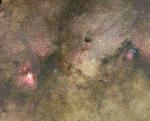 APOD: 2002 September 18- A Sagittarius Starscape
18.09.2002
Many vast star fields in the plane of our Milky Way Galaxy are rich in clouds of stars, dust, and gas. First and foremost, visible in the above picture are millions of stars, many of which are similar to our Sun.
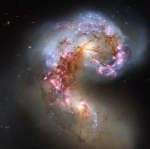 The Antennae Galaxies in Collision
3.12.2020
Sixty million light-years away toward the southerly constellation Corvus, these two large galaxies are colliding. The cosmic train wreck captured in stunning detail in this Hubble Space Telescope snapshot takes hundreds of millions of years to play out. Cataloged as NGC 4038 and NGC 4039, the galaxies' individual stars don't often collide though.
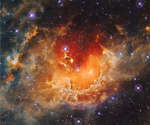 Star Formation in the Tadpole Nebula
17.11.2014
Dusty emission in the Tadpole nebula, IC 410, lies about 12,000 light-years away in the northern constellation Auriga. The cloud of glowing gas is over 100 light-years across, sculpted by stellar winds and radiation from embedded open star cluster NGC 1893.
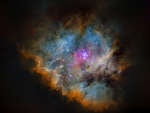 NGC 281: Starless with Stars
19.11.2021
In visible light the stars have been removed from this narrow-band image of NGC 281, a star forming region some 10,000 light-years away toward the constellation Cassiopeia. Stars were digitally added back to the resulting starless image though.
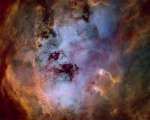 The Tadpole Nebula in Gas and Dust
19.12.2022
What's causing the commotion in the Tadpole Nebula? Star formation. Dusty emission in the Tadpole Nebula, IC 410, lies about 12,000 light-years away in the northern constellation of the Charioteer (Auriga).
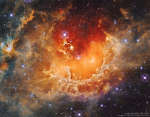 Star Formation in the Tadpole Nebula
28.01.2020
What's all of the commotion in the Tadpole Nebula? Star formation. Dusty emission in the Tadpole Nebula, IC 410, lies about 12,000 light-years away in the northern constellation of the Charioteer (Auriga).
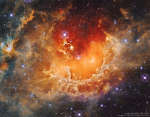 Star Formation in the Tadpole Nebula
7.05.2017
What's all of the commotion in the Tadpole nebula? Star formation. Dusty emission in the Tadpole nebula, IC 410, lies about 12,000 light-years away in the northern constellation of the Charioteer (Auriga).
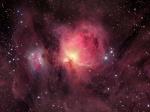 M42: Wisps of the Orion Nebula
18.09.2005
The Great Nebula in Orion, an immense, nearby starbirth region, is probably the most famous of all astronomical nebulas. Here, glowing gas surrounds hot young stars at the edge of an immense interstellar molecular cloud only 1500 light-years away. In the above deep image, faint wisps and sheets of dust and gas are particularly evident.
|
January February March April May June July August |
||||||||||||||||||||||||||||||||||||||||||||||||||||||||