
|
You entered: NASA
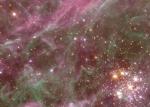 Denizen of the Tarantula Nebula
7.04.1999
The star cluster at lower right, cataloged as Hodge 301, is a denizen of the Tarantula Nebula. An evocative nebula in the southern sky, the sprawling cosmic Tarantula is an energetic star forming region some 168,000 light-years distant in our neighboring galaxy the Large Magellanic Cloud.
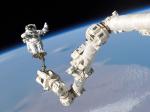 Maneuvering in Space
22.05.2006
What arm is 17 meters long and sometimes uses humans for fingers? The Canadarm2 aboard the International Space Station (ISS). Canadarm2 has multiple joints and is capable of maneuvering payloads as massive as 116,000 kilograms, equivalent to a fully loaded bus. Canadarm2 is operated by remote control by a human inside the space station.
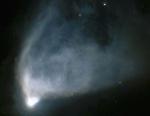 NGC 2261: Hubbles Variable Nebula
20.10.1999
What causes Hubble's Variable Nebula to vary? The unusual nebula pictured above changes its appearance noticeably in just a few weeks. Discovered over 200 years ago and subsequently cataloged as NGC 2661, the remarkable nebula is named for Edwin Hubble, who studied it earlier this century.
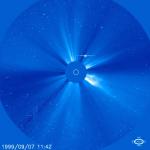 A Superior Conjunction Of Mercury
8.09.1999
In astronomical parlance, an interior planet is at superior conjunction when it is located on the opposite side of the Sun from Earth. Mercury, the solar system's innermost planet, zips past this point in its orbit today.
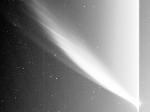 Comet McNaught from New STEREO Satellite
17.01.2007
The brightest comet of recent decades was a surprising first sight for a new camera in space. The Sun Earth Connection Coronal and Heliospheric Investigation (SECCHI) instrument onboard the Solar TErrestrial RElations Observatory (STEREO) satellite had just opened up on January 11 when it snapped the above image of Comet McNaught.
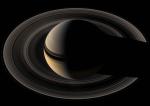 Crescent Saturn
23.10.2007
Saturn never shows a crescent phase -- from Earth. But when viewed from beyond, the majestic giant planet can show an unfamiliar diminutive sliver. This image of crescent Saturn in natural color was taken by the robotic Cassini spacecraft in May.
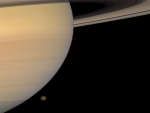 Saturn and Titan from Cassini
24.03.2008
Spectacular vistas of Saturn and its moon continue to be recorded by the Cassini spacecraft. Launched from Earth in 1997, robotic Cassini entered orbit around Saturn in 2004 and has revolutionized much of humanity's knowledge of Saturn, its expansive and complex rings, and it many old and battered moons.
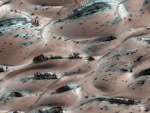 Dark Sand Cascades on Mars
19.01.2010
They might look like trees on Mars, but they're not. Groups of dark brown streaks have been photographed by the Mars Reconnaissance Orbiter on melting pinkish sand dunes covered with light frost. The above image was taken in 2008 April near the North Pole of Mars.
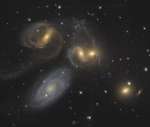 Stephan s Quintet
20.11.2010
The first identified compact galaxy group, Stephan's Quintet is featured in this eye-catching image constructed with data drawn from the extensive Hubble Legacy Archive. About 300 million light-years away, only four galaxies of the group are actually locked in a cosmic dance of repeated close encounters.
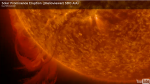 A Huge Solar Filament Erupts
15.12.2010
Click the arrow and watch an unusually long filament explode out from the Sun. The filament had been seen hovering over the Sun's surface for over a week before it erupted earlier this month.
|
January February March April May June July August September October |
|||||||||||||||||||||||||||||||||||||||||||||||||