
|
You entered: light
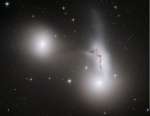 Hickson Compact Group 90
13.03.2009
Scanning the skies for galaxies, Canadian astronomer Paul Hickson and colleagues identified some 100 compact groups of galaxies, now appropriately called Hickson Compact Groups (HCGs). This sharp Hubble image shows one such galaxy group, HCG 90, in startling detail.
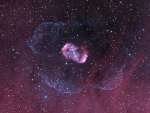 A Halo for NGC 6164
7.05.2009
Beautiful emission nebula NGC 6164 was created by a rare, hot, luminous O-type star, some 40 times as massive as the Sun. Seen at the center of the cosmic cloud, the star is a mere 3 to 4 million years old.
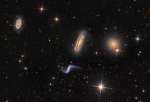 Hickson 44 in Leo
29.08.2011
Scanning the skies for galaxies, Canadian astronomer Paul Hickson and colleagues identified some 100 compact groups of galaxies, now appropriately called Hickson Compact Groups. The four prominent galaxies seen in this intriguing telescopic skyscape are one such group, Hickson 44, about 100 million light-years distant toward the constellation Leo.
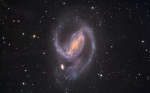 In the Arms of NGC 1097
8.01.2015
Spiral galaxy NGC 1097 shines in southern skies, about 45 million light-years away in the chemical constellation Fornax. Its blue spiral arms are mottled with pinkish star forming regions in this colorful galaxy portrait.
 In the Center of the Trifid Nebula
11.10.2015
Clouds of glowing gas mingle with dust lanes in the Trifid Nebula, a star forming region toward the constellation of the Archer (Sagittarius). In the center, the three prominent dust lanes that give the Trifid its name all come together.
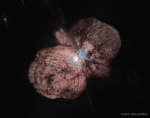 Doomed Star Eta Carinae
27.12.2015
Eta Carinae may be about to explode. But no one knows when - it may be next year, it may be one million years from now. Eta Carinae's mass - about 100 times greater than our Sun - makes it an excellent candidate for a full blown supernova.
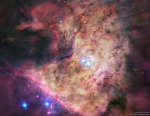 Trapezium: At the Heart of Orion
5.08.2018
Near the center of this sharp cosmic portrait, at the heart of the Orion Nebula, are four hot, massive stars known as the Trapezium. Gathered within a region about 1.5 light-years in radius, they dominate the core of the dense Orion Nebula Star Cluster.
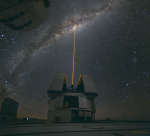 A Laser Strike at the Galactic Center
6.01.2019
Why are these people shooting a powerful laser into the center of our Galaxy? Fortunately, this is not meant to be the first step in a Galactic war. Rather, astronomers at the Very Large Telescope (VLT) site in Chile are trying to measure the distortions of Earth's ever changing atmosphere.
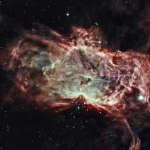 Inside the Flame Nebula
17.04.2021
The Flame Nebula is a stand out in optical images of the dusty, crowded star forming regions toward Orion's belt and the easternmost belt star Alnitak, a mere 1,400 light-years away. Alnitak is the bright star at the right edge of this infrared image from the Spitzer Space Telescope.
 Protostellar Outflows in Serpens
27.06.2024
Jets of material blasting from newborn stars, are captured in this James Webb Space Telescope close-up of the Serpens Nebula. The powerful protostellar outflows are bipolar, twin jets spewing in opposite directions. Their directions are perpendicular to accretion disks formed around the spinning, collapsing stellar infants.
|
January February March April May June July August September October |
|||||||||||||||||||||||||||||||||||||||||||||||||