
|
You entered: light
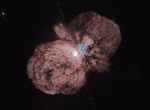 Doomed Star Eta Carinae
11.06.1996
Eta Carinae may be about to explode. But no one knows when - it may be next year, it may be one million years from now. Eta Carinae's mass - about 100 times greater than our Sun - make it an excellent candidate for a full blown supernova.
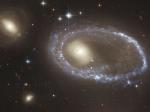 Ring Galaxy AM 0644 741 from Hubble
26.04.2004
How could a galaxy become shaped like a ring? The rim of the blue galaxy pictured on the right is an immense ring-like structure 150,000 light years in diameter composed of newly formed, extremely bright, massive stars.
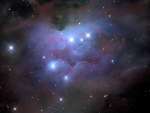 Reflections on the 1970s
20.12.2007
The 1970s are sometimes ignored by astronomers. In particular, this beautiful grouping of reflection nebulae in Orion - NGC 1977, NGC 1975, and NGC 1973 - are usually overlooked in favor of the substantial glow from the nearby stellar nursery better known as the Orion Nebula.
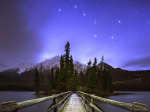 Big Dipper over Pyramid Mountain
21.11.2017
When did you first learn to identify this group of stars? Although they are familiar to many people around the world, different cultures have associated this asterism with different icons and folklore. Known...
 Vega and Comet 12P Pons-Brooks
8.12.2023
On December 4, periodic Comet 12P/Pons-Brooks shared this telescopic field of view with Vega, alpha star of the northern constellation Lyra. Fifth brightest star in planet Earth's night, Vega is some 25 light-years distant while the much fainter comet was about 21 light-minutes away.
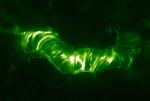 AR9077: Solar Magnetic Arcade
20.07.2000
On July 14th, solar active region 9077 (AR9077) produced a massive flare. The event also blasted an enormous cloud of energetic charged particles toward planet Earth, triggering magnetic storms and dramatic auroral displays. This striking close-up of AR9077 was made by the orbiting TRACE satellite shortly after the flare erupted.
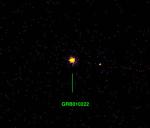 GRB010222: Gamma Ray Burst, X Ray Afterglow
13.04.2001
A fading afterglow from one of the most powerful explosions in the universe is centered in this false color image from the spacebased Chandra X-ray Observatory. The cosmic explosion, an enormously bright gamma-ray burst (GRB), originated in a galaxy billions of light-years away and was detected by the BeppoSAX satellite on February 22.
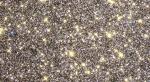 The Center of Globular Cluster Omega Centauri
10.10.2001
What is left over after stars collide? To help answer this question, astronomers have been studying the center of the most massive ball of stars in our Milky Way Galaxy. In the center of globular cluster Omega Centauri, stars are packed in 10,000 times more densely than near our Sun.
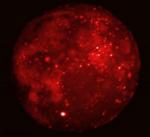 Eclipsed Moon in Infrared
8.11.2003
The total lunar eclipse of September 1996 disappointed many observers in North America who were cursed with cloudy skies. However, the Midcourse Space Experiment (MSX) satellite had a spectacular view from Earth orbit and SPIRIT III, an on board infrared telescope, was used to repeatedly image the moon during the eclipse.
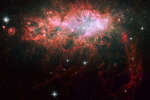 NGC 1569: Starburst in a Dwarf Irregular Galaxy
29.12.2008
Grand spiral galaxies often seem to get all the glory, flaunting their young, bright, blue star clusters in beautiful, symmetric spiral arms. But small, irregular galaxies form stars too. In fact, as pictured here...
|
January February March April May June July August September October |
|||||||||||||||||||||||||||||||||||||||||||||||||