
|
You entered: X-ray
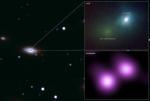 SN 2006GY: Brightest Supernova
10.05.2007
The stellar explosion cataloged as supernova SN 2006gy shines in this wide-field image (left) of its host galaxy, NGC 1260, and expanded view (upper right panel) of the region surrounding the galaxy's core.
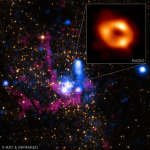 The Milky Way s Black Hole
13.05.2022
There's a black hole at the center of the Milky Way. Stars are observed to orbit a very massive and compact object there known as Sgr A* (say "sadge-ay-star"). But this just released...
 SNR 0104: An Unusual Suspect
12.06.2009
SNR 0104 is a supernova remnant with an unusual shape. Found 190,000 light-years away in our neighboring galaxy the Small Magellanic Cloud, SNR 0104 is suspected of being the expanding debris cloud from a Type 1a supernova - the catastrophic thermonuclear explosion of a white dwarf star.
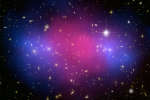 MACSJ0025: Two Giant Galaxy Clusters
Collide
MACSJ0025: Two Giant Galaxy Clusters
Collide
17.09.2008
What happens when two of the largest objects in the universe collide? No one was quite sure, but the answer is giving clues to the nature of mysterious dark matter. In the case of MACSJ0025.
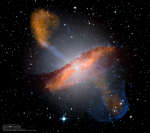 Centaurus As Warped Magnetic Fields
21.04.2021
When galaxies collide -- what happens to their magnetic fields? To help find out, NASA pointed SOFIA, its flying 747, at galactic neighbor Centaurus A to observe the emission of polarized dust -- which traces magnetic fields.
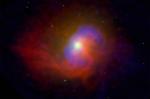 NGC 4696: Energy from a Black Hole
27.04.2006
In many cosmic environments, when material falls toward a black hole energy is produced as some of the matter is blasted back out in jets. In fact, such black hole "engines" appear to be the most efficient in the Universe, at least on a galactic scale.
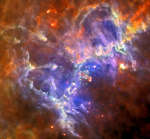 Inside the Eagle Nebula
3.02.2012
In 1995, a now famous picture from the Hubble Space Telescope featured Pillars of Creation, star forming columns of cold gas and dust light-years long inside M16, the Eagle Nebula. This remarkable false-color composite image revisits the nearby stellar nursery with image data from the orbiting Herschel Space Observatory and XMM-Newton telescopes.
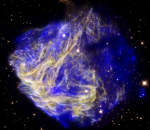 Fast Gas Bullet from Cosmic Blast N49
30.06.2010
What is that strange blue blob on the far right? No one is sure, but it might be a speeding remnant of a powerful supernova that was unexpectedly lopsided. Scattered debris from supernova explosion N49 lights up the sky in this gorgeous composited image based on data from the Chandra and Hubble Space Telescopes.
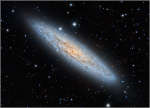 NGC 253: The Sculptor Galaxy
20.12.2011
NGC 253 is not only one of the brightest spiral galaxies visible, it is also one of the dustiest. Discovered in 1783 by Caroline Herschel in the constellation of Sculptor, NGC 253 lies only about ten million light-years distant.
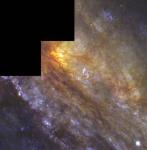 NGC 253: The Sculptor Galaxy
9.12.1998
NGC 253 is not only one of the brightest spiral galaxies visible, it is also one of the dustiest. Discovered in 1783 by Caroline Herschel in the constellation of Sculptor, NGC 253 lies only about ten million light-years distant.
|
January February March April May June July August September October |
|||||||||||||||||||||||||||||||||||||||||||||||||