
|
You entered: X-ray
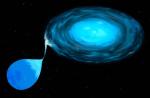 Accretion Disk Binary System
18.12.1999
Our Sun is unusual in that it is alone - most stars occur in multiple or binary systems. In a binary system, the higher mass star will evolve faster and will eventually become a compact object - either a white dwarf star, a neutron star, or black hole.
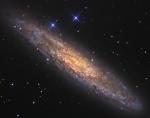 NGC 253: Dusty Island Universe
21.04.2006
Shiny NGC 253, sometimes called the Silver Dollar Galaxy, is one of the brightest spiral galaxies visible - and also one of the dustiest. First swept up in 1783 by mathematician and astronomer Caroline Herschel, the dusty island universe lies a mere 10 million light-years away in the southern constellation Sculptor.
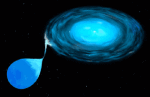 Accretion Disk Binary System
25.12.1995
Our Sun is unusual in that it is alone - most stars occur in multiple or binary systems. In a binary system, the higher mass star will evolve faster and will eventually become a compact object - either a white dwarf star, a neutron star, or black hole.
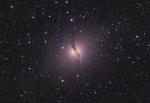 Jumbled Galaxy Centaurus A
30.06.2007
At the center of this sharp skyscape, Centaurus A seems to be a fantastic jumble of old yellow stars, young blue star clusters, and imposing dark dust lanes. Spanning over 60,000 light-years, the peculiar elliptical galaxy is apparently the result of a collision of two otherwise normal galaxies.
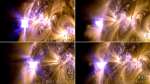 Four X-class Flares
16.05.2013
Swinging around the Sun's eastern limb on Monday, a group of sunspots labeled active region AR1748 has produced the first four X-class solar flares of 2013 in less than 48 hours. In time sequence clockwise from the top left, flashes from the four were captured in extreme ultraviolet images from the Solar Dynamics Observatory.
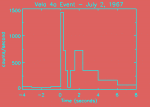 Gamma Ray Burst: A Milestone Explosion
2.07.2000
Gamma-Ray Bursts (GRBs) were discovered by accident. Thirty three years ago today, satellites first recorded a GRB. The data plotted here show that the count rate of the satellite gamma-ray instrument abruptly jumped indicating a sudden flash of gamma-rays.
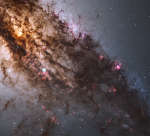 Central Centaurus A
21.02.2020
A mere 11 million light-years away, Centaurus A is the closest active galaxy to planet Earth. Also known as NGC 5128, the peculiar elliptical galaxy is over 60,000 light-years across. A region spanning about 8,500 light-years, including the galaxy's center (upper left), is framed in this sharp Hubble Space telescope close-up.
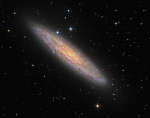 NGC 253: Dusty Island Universe
2.11.2016
Shiny NGC 253 is one of the brightest spiral galaxies visible, and also one of the dustiest. Some call it the Silver Dollar Galaxy for its appearance in small telescopes, or just the Sculptor Galaxy for its location within the boundaries of the southern constellation Sculptor.
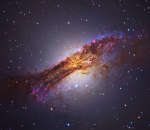 Centaurus A
18.11.2015
What's the closest active galaxy to planet Earth? That would be Centaurus A, only 11 million light-years distant. Spanning over 60,000 light-years, the peculiar elliptical galaxy is also known as NGC 5128.
 NGC 253: Dusty Island Universe
14.02.2024
Shiny NGC 253 is one of the brightest spiral galaxies visible, and also one of the dustiest. Some call it the Silver Coin Galaxy for its appearance in small telescopes, or just the Sculptor Galaxy for its location within the boundaries of the southern constellation Sculptor.
|
January February March April May June July August September October |
|||||||||||||||||||||||||||||||||||||||||||||||||