
|
You entered: stars
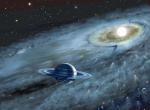 Fomalhaut Dust Disk Indicates Planets
11.10.2002
One of the brightest stars on the sky likely has planets. Fomalhaut, actually the 17th brightest star in the night sky, is a mere 22 light-years away but only a fraction of the age of our Sun.
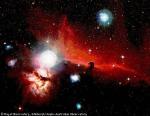 Orion's Horsehead Nebula
25.10.1997
The Horsehead Nebula is one of the most famous nebulae on the sky. It is visible as the black indentation to the red emission nebula seen just to the right of center of the above photograph. The bright star near the center is located in the belt of the familiar constellation of Orion.
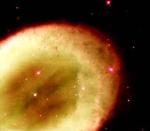 M57: The Ring Nebula
4.05.1998
It looked like a ring on the sky. Hundreds of years ago astronomers noticed a nebula with a most unusual shape. Now known as M57 or NGC 6720, the gas cloud became popularly known as the Ring Nebula.
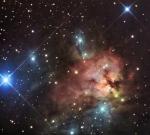 NGC 1579: Trifid of the North
25.05.2006
Colorful NGC 1579 resembles the better known Trifid Nebula, but lies much farther north in planet Earth's sky, in the heroic constellation Perseus. About 2,100 light-years away and 3 light-years across, NGC 1579 is a captivating study in color.
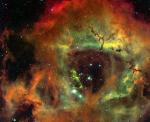 The Rosette Nebula in Hydrogen, Oxygen, and Sulfur
11.01.2000
The Rosette Nebula is a large emission nebula located 3000 light-years away. The great abundance of hydrogen gas gives NGC 2237 its red color in most photographs. The wind from the open cluster of stars known as NGC 2244 has cleared a hole in the nebula's center.
 The Tidal Tail of NGC 3628
27.07.2007
A mere 30 million light-years away, large spiral galaxy NGC 3628 (center) shares its neighborhood in the local Universe with two other large spirals, in a magnificent grouping otherwise known as the Leo Triplett.
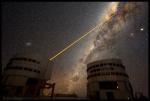 A Laser Strike at the Galactic Center
31.07.2007
Why are these people shooting a powerful laser into the center of our Galaxy? Fortunately, this is not meant to be the first step in a Galactic war. Rather, astronomers at the Very Large Telescope (VLT) site in Chile are trying to measure the distortions of Earth's ever changing atmosphere.
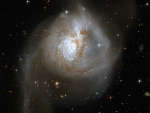 Galaxies Collide in NGC 3256
6.05.2008
Galaxies don't normally look like this. NGC 3256 actually shows a current picture of two galaxies that are slowly colliding. Quite possibly, in hundreds of millions of years, only one galaxy will remain.
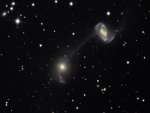 Galaxies on a String
31.07.2008
Galaxies NGC 5216 (top right) and NGC 5218 really do look like they are connected by a string. Of course, that string is a cosmic trail of gas, dust, and stars about 22,000 light-years long.
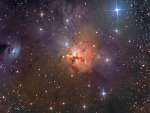 NGC 1579: Trifid of the North
30.01.2009
Colorful NGC 1579 resembles the better known Trifid Nebula, but lies much farther north in planet Earth's sky, in the heroic constellation Perseus. About 2,100 light-years away and 3 light-years across...
|
January February March April May June July August September October |
|||||||||||||||||||||||||||||||||||||||||||||||||