
|
You entered: stars
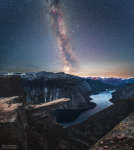 Milky Way over Trolls Tongue
11.09.2018
You have to take a long hike to see the Troll's Tongue -- ten hours over rocky terrain. And in this case, it took three trips to capture the landform below a clear night sky. Trolltunga itself is a picturesque rock protrusion extending about 700 meters over mountainous cliffs near Lake Ringedalsvatnet in Norway.
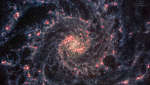 Spiral Galaxy M74: A Sharper View
22.07.2022
Beautiful spiral galaxy Messier 74 (also known as NGC 628) lies some 32 million light-years away toward the constellation Pisces. An island universe of about 100 billion stars with two prominent spiral arms, M74 has long been admired by astronomers as a perfect example of a grand-design spiral galaxy.
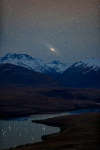 Andromeda in Southern Skies
21.10.2022
Looking north from southern New Zealand, the Andromeda Galaxy never gets more than about five degrees above the horizon. As spring comes to the southern hemisphere, in late September Andromeda is highest in the sky around midnight though.
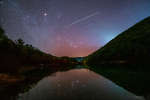 The Geminid
16.12.2022
Returning from beyond the Moon, on December 11 the Orion spacecraft entered Earth's atmosphere at almost 11 kilometers per second. That's half the speed of the grain of dust that created this long fireball meteor when it entered the atmosphere on December 13, near the peak of the annual Geminid meteor shower.
 Little Planet Aurora
25.11.2023
Immersed in an eerie greenish light, this rugged little planet appears to be home to stunning water falls and an impossibly tall mountain. It's planet Earth of course. On the night of November 9 the nadir-centered 360 degree mosaic was captured by digital camera from the Kirkjufell mountain area of western Iceland.
 APOD: 2024 February 21 Б Seagull Nebula over Pinnacles Peak
21.02.2024
The bird is bigger than the peak. Nicknamed for its avian shape, the Seagull Nebula is an emission nebula on the night sky that is vast, spanning an angle over five times the diameter of the full moon and over 200 light years.
 APOD: 2025 July 10 Б Lynds Dark Nebula 1251
10.07.2025
Stars are forming in Lynds Dark Nebula (LDN) 1251. About 1,000 light-years away and drifting above the plane of our Milky Way galaxy, LDN 1251 is also less appetizingly known as "The Rotten Fish Nebula." The dusty molecular cloud is part of a complex of dark nebulae mapped toward the Cepheus flare region.
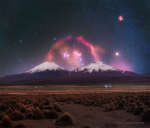 APOD: 2026 July 28 Б Barnards Loop over Twin Volcanoes
28.07.2026
What's connecting these two volcanoes? In ancient folklore, the two volcanoes, Parinacota (left) and Pomerape (right), are connected by representing a mythical prince and princess who engaged in a forbidden romance. Beneath...
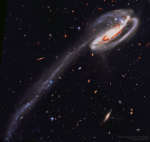 The Tadpole Galaxy from Hubble
21.06.2021
Why does this galaxy have such a long tail? In this stunning vista, based on image data from the Hubble Legacy Archive, distant galaxies form a dramatic backdrop for disrupted spiral galaxy Arp 188, the Tadpole Galaxy. The cosmic tadpole is a mere 420 million light-years distant toward the northern constellation of the Dragon (Draco).
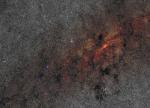 The Galactic Center in Infrared
16.07.2006
The center of our Galaxy is a busy place. In visible light, much of the Galactic Center is obscured by opaque dust. In infrared light, however, dust glows more and obscures less, allowing nearly one million stars to be recorded in the above photograph.
|
January February March April May June July August September October |
|||||||||||||||||||||||||||||||||||||||||||||||||