
|
You entered: sky
 APOD: 2024 March 31 Б Total Solar Eclipse Below the Bottom of the World
30.03.2024
In late 2021 there was a total solar eclipse visible only at the end of the Earth. To capture the unusual phenomenon, airplanes took flight below the clouded seascape of Southern Ocean. The featured...
 A Perseid Below
8.08.2024
Denizens of planet Earth typically watch meteor showers by looking up. But this remarkable view, captured on August 13, 2011 by astronaut Ron Garan, caught a Perseid meteor by looking down. From Garan...
 APOD: 2026 September 2 Б Solar Eclipses and Culture
1.09.2026
Pretend you have never heard of a solar eclipse. The SunБs behavior has been predictable your whole life. One day, you witness the sky transform as it does in todayБs spliced image spanning two hours of the August 12, 2026 solar eclipse. The Sun disappears, leaving behind a bright, empty ring.
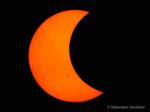 Solstice And Season's Eclipse
20.12.2000
Today the Sun reaches its southernmost point in planet Earth's sky at 13:37 UT. This celestial event is known as a solstice, marking the beginning of Summer in the Southern Hemisphere and Winter in the North.
 Hypatia of Alexandria
12.01.2002
Sixteen hundred years ago, Hypatia became one of the world's leading scholars in mathematics and astronomy. Hypatia's legendary knowledge, modesty, and public speaking ability flourished during the era of the Great Library of Alexandria.
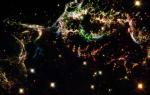 Recycling Cassiopeia A
12.07.2002
For billions of years, massive stars in our Milky Way Galaxy have lived spectacular lives. Collapsing from vast cosmic clouds, their nuclear furnaces ignite and create heavy elements in their cores. After a few million years, the enriched material is blasted back into interstellar space where star formation begins anew.
 A High Energy Fleet
25.05.1997
Looking like a fleet of futuristic starcruisers, NASA's highly successful series of High Energy Astrophysical Observatory (HEAO) spacecraft appear poised over planet Earth. Labeled A, B, and C in this vintage illustration, the spacebased telescopes were known as HEAO-1, HEAO-2, and HEAO-3 respectively.
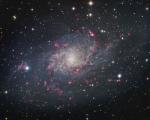 M33: Spiral Galaxy in Triangulum
24.09.2003
The small constellation Triangulum in the northern sky harbors this magnificent face-on spiral galaxy, M33. Its popular names include the Pinwheel Galaxy or just the Triangulum Galaxy. M33's diameter spans over 50,000 light-years, making it third largest in the Local Group of galaxies after the Andromeda Galaxy (M31), and our own Milky Way.
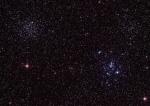 Stars Young and Old
4.08.2005
Galactic or open star clusters are relatively young swarms of bright stars born together near the plane of our Milky Way Galaxy. Separated by about a degree on the sky, two nice examples...
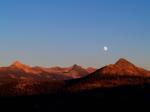 Autumn Moon Encore
14.12.2005
Near its northernmost declination, tonight's Full Moon will be a special one, arcing high in northern hemisphere skies. But a Full Moon won't occur on this calendar date for another 19 years, a period known as the lunar Metonic cycle.
|
January February March April May June July August September October |
|||||||||||||||||||||||||||||||||||||||||||||||||