
|
You entered: sky
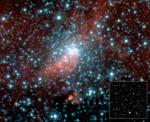 Glimpse of a Globular Star Cluster
14.10.2004
Not a glimpse of this cluster of stars can be seen in the inset visible light image (lower right). Still, the infrared view from the Spitzer Space Telescope reveals a massive globular star cluster of about 300,000 suns in an apparently empty region of sky in the constellation Aquila.
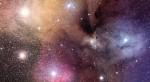 The Colorful Clouds of Rho Ophiuchi
9.07.2005
The many spectacular colors of the Rho Ophiuchi (oh'-fee-yu-kee) clouds highlight the many processes that occur there. The blue regions shine primarily by reflected light. Blue light from the star Rho Ophiuchi and nearby stars reflects more efficiently off this portion of the nebula than red light.
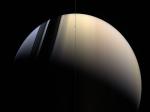 Saturn in Blue and Gold
3.05.2006
Why is Saturn partly blue? The above picture of Saturn approximates what a human would see if hovering close to the giant ringed world. The above picture was taken in mid-March by the robot Cassini spacecraft now orbiting Saturn. Here Saturn's majestic rings appear directly only as a thin vertical line.
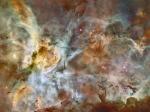 Carina Nebula Panorama from Hubble
25.04.2007
In one of the brightest parts of Milky Way lies a nebula where some of the oddest things occur. NGC 3372, known as the Great Nebula in Carina, is home to massive stars and changing nebula.
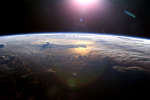 50 Years Ago: Yuri s Planet
12.04.2011
On April 12th, 1961, Soviet cosmonaut Yuri Alexseyevich Gagarin became the first human in space. His remotely controlled Vostok 1 spacecraft lofted him to an altitude of 200 miles and carried him once around planet Earth. Commenting on the first view from space he reported, "The sky is very dark; the Earth is bluish.
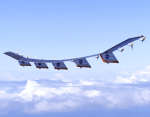 A Flight of Helios
24.07.2011
An example of solar-powered flight, NASA's Helios aircraft flew almost one hundred years after the Wright brothers' historic flight on December 17, 1903. Pictured here at 3,000 meters in in skies northwest of Kauai, Hawaii, USA in August 2001, the remotely piloted Helios is traveling at about 40 kilometers per hour.
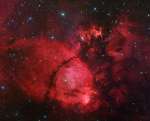 The Color of IC 1795
13.10.2011
This sharp cosmic portrait features glowing gas and obscuring dust clouds in IC 1795, a star forming region in the northern constellation Cassiopeia. Also cataloged as NGC 896, the nebula's remarkable details, shown...
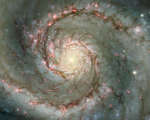 M51: The Whirlpool Galaxy in Dust and Stars
24.02.2013
The Whirlpool Galaxy is a classic spiral galaxy. At only 30 million light years distant and fully 60 thousand light years across, M51, also known as NGC 5194, is one of the brightest and most picturesque galaxies on the sky.
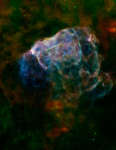 Supernova Remnant Puppis A
12.09.2014
Driven by the explosion of a massive star, supernova remnant Puppis A is blasting into the surrounding interstellar medium about 7,000 light-years away. At that distance, this remarkable false-color exploration of its complex expansion is about 180 light-years wide.
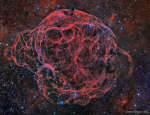 Simeis 147: Supernova Remnant
18.05.2017
It's easy to get lost following intricate filaments in this detailed image of faint supernova remnant Simeis 147. Also cataloged as Sharpless 2-240 it goes by the popular nickname, the Spaghetti Nebula. Seen toward the boundary of the constellations Taurus and Auriga, it covers nearly 3 degrees or 6 full moons on the sky.
|
January February March April May June July August September October |
|||||||||||||||||||||||||||||||||||||||||||||||||