
|
You entered: sky
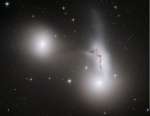 Hickson Compact Group 90
13.03.2009
Scanning the skies for galaxies, Canadian astronomer Paul Hickson and colleagues identified some 100 compact groups of galaxies, now appropriately called Hickson Compact Groups (HCGs). This sharp Hubble image shows one such galaxy group, HCG 90, in startling detail.
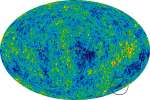 The CMB Cold Spot
21.03.2011
How could part of the early universe be so cold? No one is sure, and many astronomers now think that the CMB Cold Spot on the cosmic microwave background (CMB) radiation is not particularly noteworthy. As the early universe expanded and cooled, it suddenly and predictably became transparent.
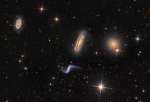 Hickson 44 in Leo
29.08.2011
Scanning the skies for galaxies, Canadian astronomer Paul Hickson and colleagues identified some 100 compact groups of galaxies, now appropriately called Hickson Compact Groups. The four prominent galaxies seen in this intriguing telescopic skyscape are one such group, Hickson 44, about 100 million light-years distant toward the constellation Leo.
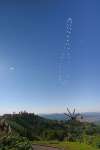 Austrian Analemma
22.09.2012
Today, the Sun crosses the celestial equator heading south at 14:49 Universal Time. An equinox (equal night), this astronomical event marks the first day of autumn in the northern hemisphere and spring in the south.
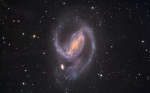 In the Arms of NGC 1097
8.01.2015
Spiral galaxy NGC 1097 shines in southern skies, about 45 million light-years away in the chemical constellation Fornax. Its blue spiral arms are mottled with pinkish star forming regions in this colorful galaxy portrait.
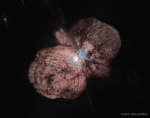 Doomed Star Eta Carinae
27.12.2015
Eta Carinae may be about to explode. But no one knows when - it may be next year, it may be one million years from now. Eta Carinae's mass - about 100 times greater than our Sun - makes it an excellent candidate for a full blown supernova.
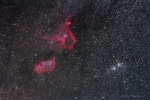 Heart and Soul and Double Cluster
24.09.2016
This rich starfield spans almost 10 degrees across the sky toward the northern constellations Cassiopeia and Perseus. On the left, heart-shaped cosmic cloud IC 1805 and IC 1848 are popularly known as the Heart and Soul nebulae.
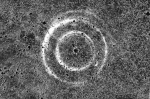 The Expanding Echoes of Supernova 1987A
24.02.2019
Can you find supernova 1987A? It isn't hard -- it occurred at the center of the expanding bullseye pattern. Although this stellar detonation was first seen in 1987, light from SN 1987A continued to bounce off clumps of interstellar dust and be reflected to us even many years later.
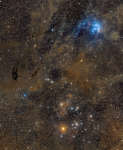 Pleiades to Hyades
6.12.2019
This cosmic vista stretches almost 20 degrees from top to bottom, across the dusty constellation Taurus. It begins at the Pleiades and ends at the Hyades, two star clusters recognized since antiquity in Earth's night sky. At top, the compact Pleiades star cluster is about 400 light-years away.
 APOD: 2024 August 13 Б Giant Jet from the International Space Station
13.08.2024
What's that on the horizon? When circling the Earth on the International Space Station early last month, astronaut Matthew Dominick saw an unusual type of lightning just beyond the Earth's edge: a gigantic jet. The powerful jet appears on the left of the featured image in red and blue.
|
January February March April May June July August September October |
|||||||||||||||||||||||||||||||||||||||||||||||||