
|
You entered: sky
 Encke and the Tadpoles
27.10.2023
History's second known periodic comet is Comet Encke (2P/Encke). As it swings through the inner Solar System, Encke's orbit takes it from an aphelion, its greatest distance from the Sun, inside the orbit of Jupiter to a perihelion just inside the orbit of Mercury.
 The Crew 8 Nebula
7.03.2024
Not the James Webb Space Telescope's latest view of a distant galactic nebula, this cloud of gas and dust dazzled spacecoast skygazers on March 3. The telephoto snapshot was taken minutes after the launch of a Falcon 9 rocket on the SpaceX Crew-8 mission, to the International Space Station.
 APOD: 2024 June 23 Б The Colors of Saturn from Cassini
23.06.2024
What creates Saturn's colors? The featured picture of Saturn only slightly exaggerates what a human would see if hovering close to the giant ringed world. The image was taken in 2005 by the robot Cassini spacecraft that orbited Saturn from 2004 to 2017.
 Bright Bolide
11.10.2008
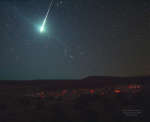
On September 30, a spectacular bolide or fireball meteor surprised a group of amateur astronomers enjoying dark night skies over the Oklahoma panhandle's Black Mesa State Park in the Midwestern US. Flashing past...
 The Colorful Clouds of Rho Ophiuchi
3.12.2013
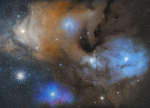
The many spectacular colors of the Rho Ophiuchi (oh'-fee-yu-kee) clouds highlight the many processes that occur there. The blue regions shine primarily by reflected light. Blue light from the star Rho Ophiuchi and nearby stars reflects more efficiently off this portion of the nebula than red light.
 NGC 4414: A Flocculent Spiral Galaxy
20.11.2016
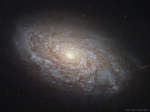
How much mass do flocculent spirals hide? The featured true color image of flocculent spiral galaxy NGC 4414 was taken with the Hubble Space Telescope to help answer this question. The featured image was augmented with data from the Sloan Digital Sky Survey (SDSS).
 The Orion You Can Almost See
21.08.2019
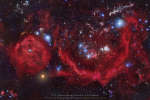
Do you recognize this constellation? Although it is one of the most recognizable star groupings on the sky, this is a more full Orion than you can see -- an Orion only revealed with long exposure digital camera imaging and post-processing.
 APOD: 2023 May 21 Б Tardigrade in Moss
21.05.2023
Is this an alien? Probably not, but of all the animals on Earth, the tardigrade might be the best candidate. That's because tardigrades are known to be able to go for decades without...
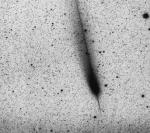 Hale Bopp: A Continuing Tail
20.02.1998
Where is Hale-Bopp now? The Great Comet of 1997, one of the largest and most active comets ever, is outbound about 400 million miles from the sun. Too faint for viewing without telescopes or binoculars, Hale-Bopp is presently positioned in the very southerly constellation of Pictor.
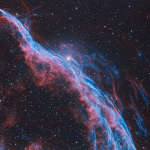 NGC 6960: The Witch s Broom Nebula
29.05.2013
Ten thousand years ago, before the dawn of recorded human history, a new light would have suddenly have appeared in the night sky and faded after a few weeks. Today we know this light was from a supernova, or exploding star, and record the expanding debris cloud as the Veil Nebula, a supernova remnant.
|
January February March April May June July August September October |
|||||||||||||||||||||||||||||||||||||||||||||||||