
|
You entered: filaments
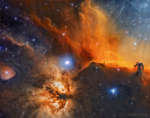 The Horsehead and Flame Nebulas
3.11.2021
The Horsehead Nebula is one of the most famous nebulae on the sky. It is visible as the dark indentation to the orange emission nebula at the far right of the featured picture. The horse-head feature is dark because it is really an opaque dust cloud that lies in front of the bright emission nebula.
 Spitzer s Milky Way
5.06.2008
The Spitzer Space Telescope's encompasing infrared view of the plane of our Milky Way Galaxy is hard to appreciate in just one picture. In fact, more than 800,000 frames of data from...
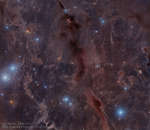 Dark Nebulas across Taurus
14.03.2016
Sometimes even the dark dust of interstellar space has a serene beauty. One such place occurs toward the constellation of Taurus. The filaments featured here can be found on the sky between the Pleiades star cluster and the California Nebula.
 APOD: 2025 July 29 Б A Helix Nebula Deep Field
29.07.2025
Is the Helix Nebula looking at you? No, not in any biological sense, but it does look quite like an eye. The Helix Nebula is so named because it also appears that you are looking down the axis of a helix.
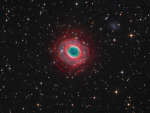 Exploring the Ring
18.09.2008
A familiar sight for northern hemisphere astronomers, the Ring Nebula (M57) is some 2,000 light-years away in the musical constellation Lyra. The central ring is about one light-year across, but this remarkably deep...
 A Dusty Iris Nebula
10.06.2009
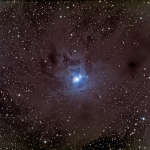
These clouds of interstellar dust and gas have blossomed 1,300 light-years away in the fertile star fields of the constellation Cepheus. Sometimes called the Iris Nebula and dutifully cataloged as NGC 7023, this is not the only nebula in the sky to evoke the imagery of flowers.
 Simeis 147: Supernova Remnant
12.02.2011
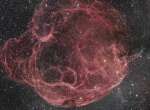
It's easy to get lost following the intricate filaments in this detailed mosaic image of faint supernova remnant Simeis 147. Also cataloged as Sh2-240 and seen towards the constellation Taurus, it covers nearly 3 degrees (6 full moons) on the sky.
 A Dusty Iris Nebula
4.08.2011
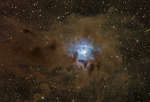
These clouds of interstellar dust and gas have blossomed 1,300 light-years away in the fertile star fields of the constellation Cepheus. Sometimes called the Iris Nebula and dutifully cataloged as NGC 7023, this is not the only nebula in the sky to evoke the imagery of flowers.
 WR32 and Interstellar Clouds in Carina
8.02.2021
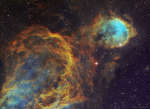
Stars can be like artists. With interstellar gas as a canvas, a massive and tumultuous Wolf-Rayet star has created the picturesque ruffled half-circular filaments called WR32, on the image left. Additionally, the winds...
 APOD: 2025 June 2 Б Veil Nebula: Wisps of an Ancient Supernova
2.06.2025
Wisps like this are all that remain visible of a Milky Way star. About 7,000 years ago that star exploded in a supernova, leaving the Veil Nebula. At the time, the expanding cloud was likely as bright as a crescent Moon, remaining visible for weeks to people living at the dawn of recorded history.
|
January February March April May June July August September |
|||||||||||||||||||||||||||||||||||||||||||||||||