
|
You entered: filaments
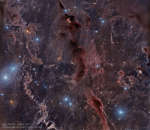 Dark Nebulas across Taurus
26.06.2018
Sometimes even the dark dust of interstellar space has a serene beauty. One such place occurs toward the constellation of Taurus. The filaments featured here can be found on the sky between the Pleiades star cluster and the California Nebula.
 M16: Inside the Eagle Nebula
28.12.2020
From afar, the whole thing looks like an Eagle. A closer look at the Eagle Nebula, however, shows the bright region is actually a window into the center of a larger dark shell of dust. Through this window, a brightly-lit workshop appears where a whole open cluster of stars is being formed.
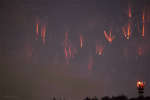 Red Sprite Lightning over the Czech Republic
12.09.2022
What are those red filaments in the sky? They are a rarely seen form of lightning confirmed only about 35 years ago: red sprites. Research has shown that following a powerful positive cloud-to-ground lightning...
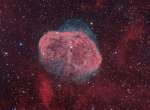 NGC 6888: The Crescent Nebula
13.08.2008
NGC 6888, also known as the Crescent Nebula, is a cosmic bubble about 25 light-years across, blown by winds from its central, bright, massive star. This beautiful telescopic view combines a composite color image with narrow band data that isolates light from hydrogen and oxygen atoms in the wind-blown nebula.
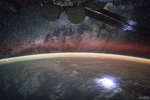 Space Station Vista: Planet and Galaxy
18.01.2017
If you could circle the Earth aboard the International Space Station, what might you see? Some amazing vistas, one of which was captured in this breathtaking picture in mid-2015. First, visible at the top, are parts of the space station itself including solar panels.
 The Pencil Nebula Supernova Shock Wave
23.02.2024
This supernova shock wave plows through interstellar space at over 500,000 kilometers per hour. Centered and moving upward in the sharply detailed color composite its thin, bright, braided filaments are actually long ripples in a cosmic sheet of glowing gas seen almost edge-on.
 A Flight Through the Universe
13.08.2012
What would it be like to fly through the universe? Possibly the best simulated video of this yet has been composed from recently-released galaxy data from the Sloan Digital Sky Survey. Every spot in the above video is a galaxy containing billions of stars.
 Sun Storm: A Coronal Mass Ejection
10.01.2016
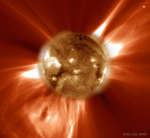
What's happening to our Sun? Another Coronal Mass Ejection (CME)! The Sun-orbiting SOHO spacecraft has imaged many erupting filaments lifting off the active solar surface and blasting enormous bubbles of magnetic plasma into space.
 NGC 6357: Stellar Wonderland
26.12.2016
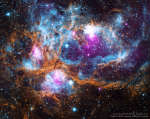
For reasons unknown, NGC 6357 is forming some of the most massive stars ever discovered. This complex wonderland of star formation consists of numerous filaments of dust and gas surrounding huge cavities of massive star clusters. The intricate patterns are caused by complex interactions between interstellar winds, radiation pressures, magnetic fields, and gravity.
 At the Edge of NGC 891
26.05.2012
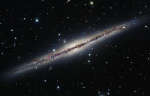
This sharp cosmic portrait features NGC 891. The spiral galaxy spans about 100 thousand light-years and is seen almost exactly edge-on from our perspective. In fact, about 30 million light-years distant in the constellation Andromeda, NGC 891 looks a lot like our Milky Way.
|
January February March April May June July August September |
|||||||||||||||||||||||||||||||||||||||||||||||||