
|
You entered: temperature
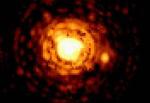 Small Star
5.06.1997
A dim double star system cataloged as Gliese 623 lies 25 light-years from Earth, in the constellation of Hercules. The individual stars of this binary system were distinguished for the first time when the Hubble Space Telescope's Faint Object Camera recorded this image in June 1994.
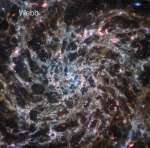 Webb and Hubble: IC 5332
26.02.2026
What does the universe look like through infrared goggles? Our eyes can only see visible light, but astronomers want to see more. TodayБs APOD shows spiral galaxy IC 5332 as seen by two NASA telescopes: Webb in mid-infrared and Hubble in ultraviolet and visible light.
 APOD: 2025 May 11 Б The Surface of Venus from Venera 14
11.05.2025
If you could stand on Venus -- what would you see? Pictured is the view from Venera 14, a robotic Soviet lander which parachuted and air-braked down through the thick Venusian atmosphere in March of 1982.
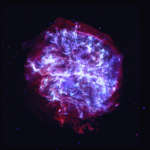 Elements in the Aftermath
1.08.2019
Massive stars spend their brief lives furiously burning nuclear fuel. Through fusion at extreme temperatures and densities surrounding the stellar core, nuclei of light elements ike Hydrogen and Helium are combined to heavier elements like Carbon, Oxygen, etc. in a progression which ends with Iron.
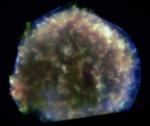 X Rays From Tycho s Supernova Remnant
12.09.2002
In 1572, Danish astronomer Tycho Brahe recorded the sudden appearance of a bright new star in the constellation Cassiopeia. The new star faded from view over a period of months and is believed to have been a supernova, one of the last stellar explosions seen in our Milky Way galaxy.
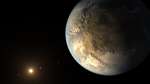 Earth size Kepler 186f
19.04.2014
Planet Kepler-186f is the first known Earth-size planet to lie within the habitable zone of a star beyond the Sun. Discovered using data from the prolific planet-hunting Kepler spacecraft, the distant world orbits...
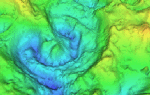 Impact! 65 Million Years Ago
12.10.1997
What killed the dinosaurs? Their sudden disappearance 65 million years ago, along with about 70 percent of all species then living on Earth, is known as the K-T event (Cretaceous-Tertiary Mass Extinction event). Geologists and paleontologists often entertain the idea of a large asteroid
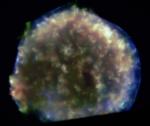 X Rays From Tycho s Supernova Remnant
22.05.2004
In 1572, Danish astronomer Tycho Brahe recorded the sudden appearance of a bright new star in the constellation Cassiopeia. The new star faded from view over a period of months and is believed to have been a supernova, one of the last stellar explosions seen in our Milky Way galaxy.
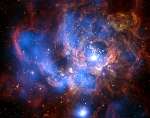 NGC 604: X rays from a Giant Stellar Nursery
5.02.2009
Some 3 million light-years distant in nearby spiral galaxy M33, giant stellar nursery NGC 604 is about 1,300 light-years across, or nearly 100 times the size of the Orion Nebula. In fact, among...
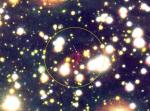 375: Candidate Quark Star
14.04.2002
Why is RJX J185635-375 so cool and so dim? Previously, this compact star held claim to being the closest neutron star -- only 150 light-years away. Now new observations and analysis indicate not only a cool temperature for RXJ J185635-375, pictured above, but also a larger distance: roughly 450 light-years away.
|
January February March April May June July August September October |
|||||||||||||||||||||||||||||||||||||||||||||||||