
|
You entered: temperature
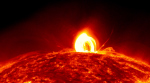 Coronal Rain on the Sun
27.05.2018
Does it rain on the Sun? Yes, although what falls is not water but extremely hot plasma. An example occurred in mid-July 2012 after an eruption on the Sun that produced both a Coronal Mass Ejection and a moderate solar flare. What was more unusual, however, was what happened next.
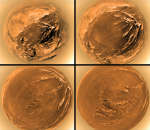 Huygens Lands on Titan
15.01.2015
Delivered by Saturn-bound Cassini, ESA's Huygens probe touched down on the ringed planet's largest moon Titan, ten years ago on January 14, 2005. These panels show fisheye images made during its slow descent by parachute through Titan's dense atmosphere.
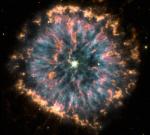 Celebrating Hubble With NGC 6751
7.04.2000
Planetary nebulae do look simple, round, and planet-like in small telescopes. But images from the orbiting Hubble Space Telescope have become well known for showing these fluorescent gas shrouds of dying Sun-like stars to possess a staggering variety of detailed symmetries and shapes.
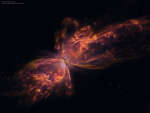 The Butterfly Nebula from Hubble
8.02.2017
The bright clusters and nebulae of planet Earth's night sky are often named for flowers or insects. Though its wingspan covers over 3 light-years, NGC 6302 is no exception. With an estimated surface...
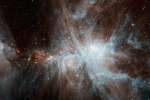 Spitzer's Orion
31.08.2019
Few cosmic vistas excite the imagination like the Orion Nebula, an immense stellar nursery some 1,500 light-years away. Spanning about 40 light-years across the region, this infrared image from the Spitzer Space Telescope...
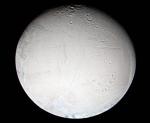 Ski Enceladus
24.02.2005
Small, icy, inner moon of Saturn, Enceladus is only about 500 kilometers in diameter. But the distant world does reflect over 90 percent of the sunlight it receives, giving its surface about the same reflectivity as fresh snow.
 APOD: 2025 November 30 Б The Surface of Titan from Huygens
30.11.2025
If you could stand on Titan -- what would you see? The featured color viewa from Titan gazes across an unfamiliar and distant landscape on Saturn's largest moon. The scene was recorded by ESA's Huygens probe in 2005 after a 2.5-hour descent through a thick atmosphere of nitrogen laced with methane.
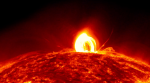 Coronal Rain on the Sun
26.02.2013
Does it rain on the Sun? Yes, although what falls is not water but extremely hot plasma. An example occurred in mid-July 2012 after an eruption on the Sun that produced both a Coronal Mass Ejection and a moderate solar flare. What was more unusual, however, was what happened next.
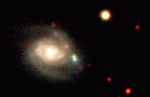 Star Wars in NGC 664
25.02.1997
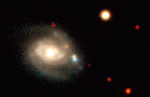
Long ago in a galaxy far, far away, locked in their final desperate struggle against the force of gravity ... two stars exploded! Stellar explosions - Supernovae - are among the most powerful events in the Universe, estimated to release an equivalent energy of up to 1 million trillion trillion (1 followed by 30 zeros) megatons of TNT.
 Star Wars in NGC 664
18.04.1998
Long ago in a galaxy far, far away, locked in their final desperate struggle against the force of gravity ... two stars exploded! stellar explosions - Supernovae - are among the most powerful events in the Universe, estimated to release an equivalent energy of up to 1 million trillion trillion (1 followed by 30 zeros) megatons of TNT.
|
January February March April May June July August September October |
|||||||||||||||||||||||||||||||||||||||||||||||||