
|
You entered: temperature
 APOD: 2025 July 22 Б A Double Detonation Supernova
22.07.2025
Can some supernovas explode twice? Yes, when the first explosion acts like a detonator for the second. This is a leading hypothesis for the cause of supernova remnant (SNR) 0509-67
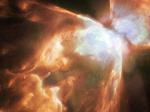 NGC 6302: Big, Bright, Bug Nebula
29.04.2007
The bright clusters and nebulae of planet Earth's night sky are often named for flowers or insects, and NGC 6302 is no exception. With an estimated surface temperature of about 250,000 degrees...
 Iron in the Butterfly Nebula
21.07.2020
Can stars, like caterpillars, transform themselves into butterflies? No, but in the case of the Butterfly Nebula -- it sure looks like it. Though its wingspan covers over 3 light-years and its estimated surface temperature...
 APOD: 2024 August 6 Б Storm Cloud Over Texas
6.08.2024
What makes this storm cloud so colorful? First, the cloud itself is composed of millions of tiny droplets of water and ice. Its bottom is almost completely flat -- but this isn't unusual. Bottom...
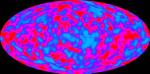 COBE Hotspots: The Oldest Structures Known
7.02.1998
Above is a microwave image of the entire sky. The plane of our galaxy runs horizontally through the center. This historic all-sky map is based on the first two years of data from NASA's COsmic Background Explorer (COBE) satellite.
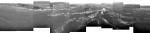 Eight Kilometers Above Titan
19.01.2005
What are these surface features on Titan? Scroll right to see the panoramic view captured last week by the Huygens probe as it descended toward Saturn's mysterious moon. Scientists are not yet sure what the above image is showing.
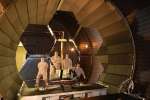 JWST: Mirrors and Masked Men
12.03.2010
Who are these masked men? Technicians from Ball Aerospace and NASA at Marshall Space Flight Center's X-ray and Cryogenic Facility, of course, testing primary mirror segments of the James Webb Space Telescope (JWST).
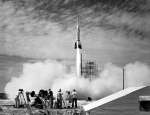 The First Rocket Launch from Cape Canaveral
19.07.2015
A new chapter in space flight began this week in 1950 July with the launch of the first rocket from Cape Canaveral, Florida: the Bumper V-2. Shown above, the Bumper V-2 was an ambitious two-stage rocket program that topped a V-2 missile base with a WAC Corporal rocket.
 GL 105C: The Coolest Star?
20.09.1995
Is the dim star to the upper right of this false-color picture the coolest possible normal star? From this recent picture by the Hubble Space Telescope, astronomers have estimated its mass is just high enough for it to fuse hydrogen into helium in its core.
 HH1/HH2: Star Jets
19.06.1997
A cloud of interstellar gas and dust collapses and a star is born. At its core temperatures rise, a nuclear furnace ignites, and a rotating dusty disk forms surrounding the newborn star. According...
|
January February March April May June July August September October |
|||||||||||||||||||||||||||||||||||||||||||||||||