
|
You entered: temperature
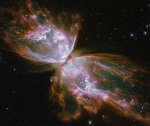 The Butterfly Nebula from Hubble
13.11.2011
Few butterflies have a wingspan this big. The bright clusters and nebulae of planet Earth's night sky are often named for flowers or insects, and NGC 6302 is no exception. With an estimated...
 APOD: 2024 May 19 Б Jupiter Diving
19.05.2024
Take this simulated plunge and dive into the upper atmosphere of Jupiter, the Solar System's ruling gas giant. The awesome animation is based on image data from JunoCam, and the microwave radiometer on board the Jupiter-orbiting Juno spacecraft.
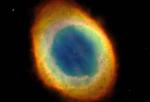 M57: The Ring Nebula
4.07.2004
Except for the rings of Saturn, the Ring Nebula (M57) is probably the most famous celestial band. This planetary nebula's simple, graceful appearance is thought to be due to perspective -- our view from planet Earth looking straight into what is actually a barrel-shaped cloud of gas shrugged off by a dying central star.
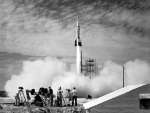 The First Rocket Launch from Cape Canaveral
1.10.2008
A new chapter in space flight began on 1950 July with the launch of the first rocket from Cape Canaveral, Florida: the Bumper 2. Shown above, the Bumper 2 was an ambitious two-stage rocket program that topped a V-2 missile base with a WAC Corporal rocket.
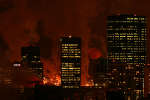 Red Snow Moon over Edmonton
28.02.2011
What's hovering between those buildings? The Moon. The above image was taken two weeks ago as the full Snow Moon started to rise above Edmonton, Alberta, Canada. The odd coincidence between the angular size of the far distant Moon and the angular width of nearby buildings created a striking juxtaposition.
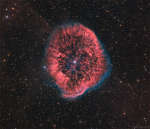 APOD: 2023 February 8 Б Stellar Wind Shaped Nebula RCW 58
8.02.2023
Imagine traveling to a star about 100 times as massive as our Sun, a million times more luminous, and with 30 times the surface temperature. Such stars exist, and some are known as Wolf Rayet (WR) stars, named after French astronomers Charles Wolf and Georges Rayet.
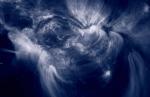 Solar Moss
27.12.1999
Discovered in recent close-up pictures of the Sun from NASA's Transition Region And Coronal Explorer (TRACE) spacecraft, this spongy-looking stuff has a temperature of 2 million degrees Fahrenheit ... and has been dubbed "Solar Moss". The false-color TRACE image above was recorded in extreme ultraviolet light on October 18.
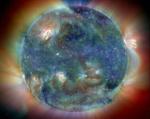 Solstice Celebration
21.12.2002
Aloha and Season's greetings! On December 22nd, at 01:14 Universal Time (December 21, 3:14pm Hawaii-Aleutian Standard Time), the Sun reaches its southernmost point in planet Earth's sky marking the final season change for the year 2002. In celebration, consider this delightfully detailed, brightly colored image of the active Sun.
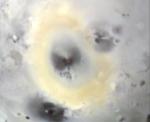 Io Volcano: Pele's Hot Lava
26.11.1999
Glowing hot lava from the heart of Io's volcano Pele is visible in this false-color infrared composite image. It was recorded last month during the Galileo spacecraft's close flyby of the Jovian moon.
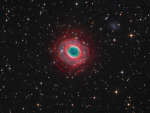 Exploring the Ring
18.09.2008
A familiar sight for northern hemisphere astronomers, the Ring Nebula (M57) is some 2,000 light-years away in the musical constellation Lyra. The central ring is about one light-year across, but this remarkably deep...
|
January February March April May June July August September October |
|||||||||||||||||||||||||||||||||||||||||||||||||