
|
You entered: NASA
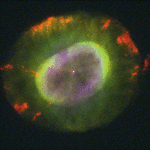 The Blue Snowball Planetary Nebula
21.11.1996
Will the Sun one day look like - a blue snowball? Maybe! The Blue Snowball is a planetary nebula - and in 5 billion years the Sun will throw off its outer layers and go through a planetary nebula phase.
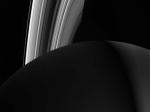 Saturn at Night
12.09.2006
This is what Saturn looks like at night. In contrast to the human-made lights that cause the nighttime side of Earth to glow faintly, Saturn's faint nighttime glow is primarily caused by sunlight reflecting off of its own majestic rings.
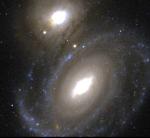 Galaxies Away
21.08.1999
This striking pair of galaxies is far, far away ... about 350 million light-years from Earth. Cataloged as AM0500-620, the pair is located in the southern constellation Dorado. The background elliptical and foreground spiral galaxy are representative of two of the three major classes of galaxies which inhabit our Universe.
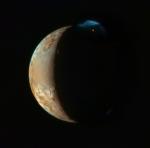 New Horizons at Io
4.04.2007
Spewed from a volcano, a complex plume rises over 300 kilometers above the horizon of Jupiter's moon Io in this image from cameras onboard the New Horizons spacecraft. The volcano, Tvashtar, is marked by the bright glow (about 1 o'clock) at the moon's edge, beyond the terminator or night/day shadow line.
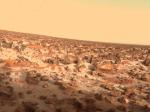 Could Hydrogen Peroxide Life Survive on Mars
28.08.2007
Is there life on Mars? Although no unambiguous evidence for indigenous life on Mars has ever been found, a more speculative question -- could some life forms survive on Mars -- has taken on a new twist.
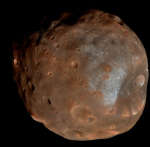 Phobos: Doomed Moon of Mars
14.04.2008
This moon is doomed. Mars, the red planet named for the Roman god of war, has two tiny moons, Phobos and Deimos, whose names are derived from the Greek for Fear and Panic. These...
 NGC 253 Close Up
2.10.2008
This dusty island universe is one of the brightest spiral galaxies in the sky. Seen nearly edge-on, NGC 253 lies a mere 13 million light-years away and is the largest member of the Sculptor Group of galaxies, neighbor to our own local galaxy group.
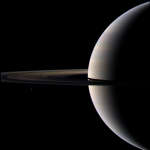 Saturn After Equinox
10.11.2009
The other side of Saturn's ring plane is now directly illuminated by the Sun. For the previous 15 years, the southern side of Saturn and its rings were directly illuminated, but since Saturn's equinox in August, the orientation has reversed.
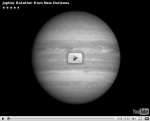 Watch Jupiter Rotate
24.01.2010
What would it be like to coast by Jupiter and watch it rotate? This was just the experience of the New Horizons spacecraft as it approached and flew by Jupiter in 2007. Clicking on the image will bring up a movie of what the robotic spacecraft saw.
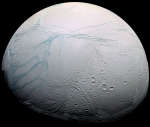 Fresh Tiger Stripes on Saturns Enceladus
6.04.2014
Do underground oceans vent through the tiger stripes on Saturn's moon Enceladus? Long features dubbed tiger stripes are known to be spewing ice from the moon's icy interior into space, creating a cloud of fine ice particles over the moon's South Pole and creating Saturn's mysterious E-ring.
|
January February March April May June July August September October |
|||||||||||||||||||||||||||||||||||||||||||||||||