
|
You entered: NASA
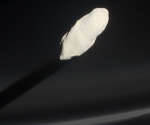 Prometheus Rising Through Saturns F Ring
19.10.2010
What is that dark streak below Prometheus? Although it may look like a shadow or a trail blazed by sweeping up material, computer simulations indicate that the dark streak is better understood as an empty path pulled away by the gravity of Saturn's small moon.
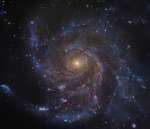 Messier 101
15.04.2011
Big, beautiful spiral galaxy M101 is one of the last entries in Charles Messier's famous catalog, but definitely not one of the least. About 170,000 light-years across, this galaxy is enormous, almost twice the size of our own Milky Way galaxy.
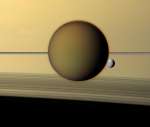 Ringside with Titan and Dione
5.01.2012
Orbiting in the plane of Saturn's rings, Saturnian moons have a perpetual ringside view of the gorgeous gas giant planet. Of course, while passing near the ring plane the Cassini spacecraft also shares their stunning perspective.
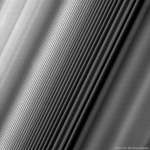 Density Waves in Saturns Rings from Cassini
8.08.2017
What causes the patterns in Saturn's rings? The Cassini spacecraft, soon ending its 13 years orbiting Saturn, has sent back another spectacular image of Saturn's immense ring system in unprecedented detail. The physical cause for some of Saturn's ring structures is not always understood.
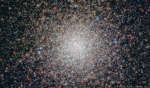 Star Cluster NGC 362 from Hubble
11.10.2017
If our Sun were near the center of NGC 362, the night sky would glow like a jewel box of bright stars. Hundreds of stars would glow brighter than Sirius, and in many different colors.
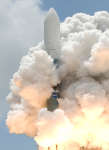 At Last GLAST
11.06.2018
Rising through a billowing cloud of smoke, a long time ago from a planet very very close by, this Delta II rocket left Cape Canaveral Air Force Station's launch pad 17-B at 12:05 pm EDT on June 11, 2008. Snug in the payload section was GLAST, the Gamma-ray Large Area Space Telescope.
 APOD: 2023 April 16 Б M2 9: Wings of a Butterfly Nebula
16.04.2023
Are stars better appreciated for their art after they die? Actually, stars usually create their most artistic displays as they die. In the case of low-mass stars like our Sun and M2-9 pictured here, the stars transform themselves from normal stars to white dwarfs by casting off their outer gaseous envelopes.
 Saturn at Night
2.11.2024
Saturn is bright in Earth's night skies. Telescopic views of the outer gas giant planet and its beautiful rings often make it a star at star parties. But this stunning view of Saturn's rings and night side just isn't possible from telescopes in the vicinity of planet Earth.
 Yogi and Friends in 3D
10.05.2025
This picture from July 1997 shows a ramp from the Pathfinder lander, the Sojourner robot rover, deflated landing airbags, a couch, Barnacle Bill and Yogi Rock appear together in this 3D stereo view of the surface of Mars. Barnacle Bill is the rock just left of the house cat-sized, solar-paneled Sojourner.
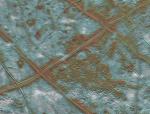 Europa: Ridges and Rafts on a Frozen Moon
10.09.1998
The large Jovian moon Europa may harbor liquid water beneath its frozen crust. Controversy surrounding this idea has been recently fueled by dramatic images of Europa's surface from the Galileo spacecraft. This alluring...
|
January February March April May June July August September October |
|||||||||||||||||||||||||||||||||||||||||||||||||