
|
You entered: light
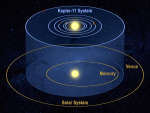 Six Worlds for Kepler 11
3.02.2011
Six worlds orbit Kepler-11, a sunlike star 2,000 light-years distant in the constellation Cygnus. The new discovery, based on data from NASA's planet hunting Kepler spacecraft, makes the Kepler-11 system the fullest exoplanetary system known.
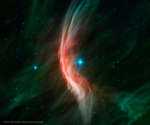 Zeta Oph: Runaway Star
5.07.2015
Like a ship plowing through cosmic seas, runaway star Zeta Ophiuchi produces the arcing interstellar bow wave or bow shock seen in this stunning infrared portrait. In the false-color view, bluish Zeta...
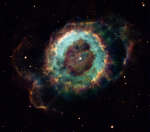 NGC 6369: The Little Ghost Nebula
28.10.2017
Wraithlike NGC 6369 is a faint apparition in night skies popularly known as the Little Ghost Nebula. It was discovered by 18th century astronomer Sir William Herschel as he used a telescope to explore the medicinal constellation Ophiucus. Herschel historically classified the round and planet-shaped nebula as a Planetary Nebula.
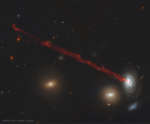 The Long Gas Tail of Spiral Galaxy D100
28.01.2019
Why is there long red streak attached to this galaxy? The streak is made mostly of glowing hydrogen that has been systematically stripped away as the galaxy moved through the ambient hot gas in a cluster of galaxies. Specifically, the galaxy is spiral galaxy D100, and cluster is the Coma Cluster of galaxies.
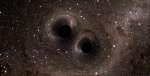 Simulation: Two Black Holes Merge
14.04.2019
Sit back and watch two black holes merge. Inspired by the first direct detection of gravitational waves in 2015, this simulation video plays in slow motion but would take about one third of a second if run in real time.
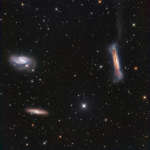 The Leo Trio
20.03.2021
This popular group leaps into the early evening sky around the March equinox and the northern hemisphere spring. Famous as the Leo Triplet, the three magnificent galaxies found in the prominent constellation Leo gather here in one astronomical field of view.
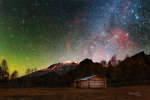 The Gum Nebula over Snowy Mountains
27.06.2022
The Gum Nebula is so large and close it is actually hard to see. This interstellar expanse of glowing hydrogen gas frequently evades notice because it spans 35 degrees -- over 70 full Moons -- while much of it is quite dim.
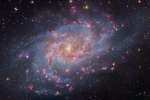 M33: The Triangulum Galaxy
3.11.2022
The small, northern constellation Triangulum harbors this magnificent face-on spiral galaxy, M33. Its popular names include the Pinwheel Galaxy or just the Triangulum Galaxy. M33 is over 50,000 light-years in diameter, third largest in the Local Group of galaxies after the Andromeda Galaxy (M31), and our own Milky Way.
 NGC 2403 in Camelopardalis
3.06.2024
Magnificent island universe NGC 2403 stands within the boundaries of the long-necked constellation Camelopardalis. Some 10 million light-years distant and about 50,000 light-years across, the spiral galaxy also seems to have more than its fair share of giant star forming HII regions, marked by the telltale reddish glow of atomic hydrogen gas.
 APOD: 2025 June 3 Б Rainbow Airglow over the Azores
3.06.2025
Why would the sky glow like a giant repeating rainbow? Airglow. Now, air glows all of the time, but it is usually hard to see. A disturbance however -- like an approaching storm -- may cause noticeable rippling in the Earth's atmosphere.
|
January February March April May June July August September October |
|||||||||||||||||||||||||||||||||||||||||||||||||