
|
You entered: light
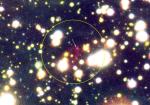 The Nebula And The Neutron Star
25.10.2000
The lonely RX J1856.5-3754 was formed from the collapsed core of an exploding star. At a distance of 180 light-years it is the closest known neutron star. More massive than...
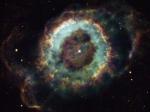 NGC 6369: The Little Ghost Nebula
7.02.2004
This pretty planetary nebula, cataloged as NGC 6369, was discovered by 18th century astronomer William Herschel as he used a telescope to explore the medicinal constellation Ophiucus. Round and planet-shaped, the nebula is also relatively faint and has acquired the popular moniker of Little Ghost Nebula.
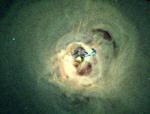 X Rays from the Perseus Cluster Core
8.12.2005
The Perseus Cluster of thousands of galaxies, 250 million light-years distant, is one of the most massive objects in the Universe and the brightest galaxy cluster in the x-ray sky. At its core lies the giant cannibal galaxy Perseus A (NGC 1275), accreting matter as gas and galaxies fall into it.
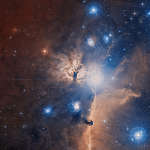 Inside the Flame Nebula
2.11.2019
The Flame Nebula stands out in this optical image of the dusty, crowded star forming regions toward Orion's belt, a mere 1,400 light-years away. X-ray data from the Chandra Observatory and infrared images from the Spitzer Space Telescope can take you inside the glowing gas and obscuring dust clouds though.
 The Southern Cliff in the Lagoon
15.05.2021
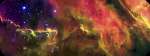
Undulating bright ridges and dusty clouds cross this close-up of the nearby star forming region M8, also known as the Lagoon Nebula. A sharp, false-color composite of narrow band visible and broad band near-infrared...
 Colors of the Moon
15.05.2022
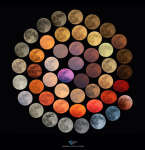
What color is the Moon? It depends on the night. Outside of the Earth's atmosphere, the dark Moon, which shines by reflected sunlight, appears a magnificently brown-tinged gray. Viewed from inside the Earth's atmosphere, though, the moon can appear quite different.
 APOD: 2024 January 7 Б The Cats Eye Nebula in Optical and X-ray
7.01.2024
To some it looks like a cat's eye. To others, perhaps like a giant cosmic conch shell. It is actually one of the brightest and most highly detailed planetary nebula known, composed of gas expelled in the brief yet glorious phase near the end of life of a Sun-like star.
 Globular Star Cluster NGC 6752
25.10.2024
Some 13,000 light-years away toward the southern constellation Pavo, the globular star cluster NGC 6752 roams the halo of our Milky Way galaxy. Over 10 billion years old, NGC 6752 follows clusters Omega Centauri, 47 Tucanae, and Messier 22 as the fourth brightest globular in planet Earth's night sky.
 Centaurus A: X Rays from an Active Galaxy
16.08.2001
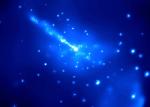
Its core hidden from optical view by a thick lane of dust, the giant elliptical galaxy Centaurus A was among the first objects observed by the orbiting Chandra X-ray Observatory. Astronomers were not disappointed, as Centaurus A's appearance in x-rays makes its classification as an active galaxy easy to appreciate.
 M44: The Beehive Cluster
22.02.2014
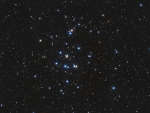
A mere 600 light-years away, M44 is one of the closest star clusters to our solar system. Also known as the Praesepe or the Beehive cluster its stars are young though, about 600 million years old compared to our Sun's 4.5 billion years.
|
January February March April May June July August September October |
|||||||||||||||||||||||||||||||||||||||||||||||||