
|
You entered: light
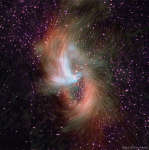 Our Galaxys Magnetic Center
18.06.2019
What's the magnetic field like in the center of our Milky Way Galaxy? To help find out, NASA's SOFIA -- an observatory flying in a modified 747 -- imaged the central region with...
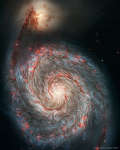 The Magnetic Field of the Whirlpool Galaxy
19.01.2021
Do magnetic fields always flow along spiral arms? Our face-on view of the Whirlpool Galaxy (M51) allows a spectacularly clear view of the spiral wave pattern in a disk-shaped galaxy. When observed with a radio telescope, the magnetic field appears to trace the arms' curvature.
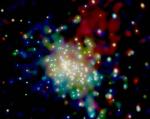 X Ray Mystery in RCW 38
26.12.2002
A mere 6,000 light-years distant and sailing through the constellation Vela, star cluster RCW 38 is full of powerful stars. It's no surprise that these stars, only a million years young with hot outer atmospheres, appear as point-like x-ray sources dotting this x-ray image from the orbiting Chandra Observatory.
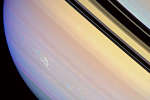 A Persistent Electrical Storm on Saturn
5.05.2008
How do large storms evolve on Saturn? On Earth, a hurricane can persist for weeks, while the Great Red Spot on Jupiter has been in existence for over 150 years. On Saturn, a storm system has now set a new endurance record, now being discernable for greater than three months.
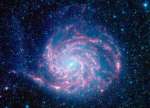 Spitzer s M101
25.07.2008
Big, beautiful spiral galaxy M101 is one of the last entries in Charles Messier's famous catalog, but definitely not one of the least. About 170,000 light-years across, this galaxy is enormous, almost twice the size of our own Milky Way Galaxy.
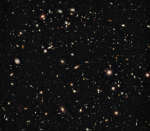 HUDF Infrared: Dawn of the Galaxies
8.12.2009
When did galaxies form? To help find out, the deepest near-infrared image of the sky ever has been taken of the same field as the optical-light Hubble Ultra Deep Field (HUDF) in 2004. The new image was taken this summer by the newly installed Wide Field Camera 3 on the refurbished Hubble Space Telescope.
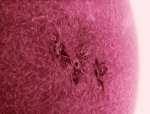 Angry Sun Erupting
14.03.2012
It's one of the baddest sunspot regions in years. Active Region 1429 may not only look, to some, like an angry bird -- it has thrown off some of the most powerful flares and coronal mass ejections of the current solar cycle.
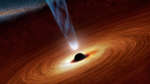 Spin up of a Supermassive Black Hole
12.03.2013
How fast can a black hole spin? If any object made of regular matter spins too fast -- it breaks apart. But a black hole might not be able to break apart -- and its maximum spin rate is really unknown.
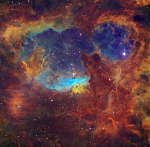 Massive Stars in NGC 6357
4.02.2016
Massive stars lie within NGC 6357, an expansive emission nebula complex some 6,500 light-years away toward the tail of the constellation Scorpius. In fact, positioned near center in this ground-based close-up...
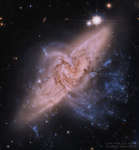 NGC 3314: When Galaxies Overlap
16.11.2021
Why doesn't the nearby galaxy create a gravitational lensing effect on the background galaxy? It does, but since both galaxies are so nearby, the angular shift is much smaller than the angular sizes of the galaxies themselves.
|
January February March April May June July August September October |
|||||||||||||||||||||||||||||||||||||||||||||||||