
|
You entered: galaxies
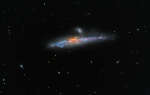 NGC 4631: The Whale Galaxy
3.06.2016
NGC 4631 is a big beautiful spiral galaxy. Seen edge-on, it lies only 25 million light-years away in the well-trained northern constellation Canes Venatici. The galaxy's slightly distorted wedge shape suggests to some a cosmic herring and to others its popular moniker, The Whale Galaxy.
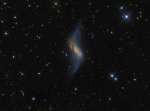 Polar Ring Galaxy NGC 660
22.01.2011
NGC 660 lies near the center of this intriguing skyscape, swimming in the boundaries of the constellation Pisces. Over 20 million light-years away, its peculiar appearance marks it as a polar ring galaxy.
 Curly Spiral Galaxy M63
22.05.2025
A bright spiral galaxy of the northern sky, Messier 63 is nearby, about 30 million light-years distant toward the loyal constellation Canes Venatici. Also cataloged as NGC 5055, the majestic island universe is nearly 100,000 light-years across, about the size of our own Milky Way.
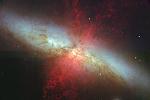 A Superwind from the Cigar Galaxy
23.11.2003
What's lighting up the Cigar Galaxy? M82, as this irregular galaxy is also known, was stirred up by a recent pass near large spiral galaxy M81. This doesn't fully explain the source of the red-glowing outwardly expanding gas, however.
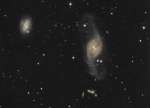 Extra Galaxies
17.07.2008
(xxxedit and linkxxx) A careful look at the full field of view for this sharp image reveals a surprising number of galaxies both near and far toward the constellation Ursa Major. The most striking is clearly NGC 3718, the warped spiral galaxy right of center.
 NGC 1316: After Galaxies Collide
22.02.1999
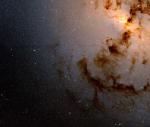
Astronomers turn detectives when trying to figure out the cause of unusual sites like NGC 1316. A preliminary inspection indicates that NGC 1316 is an enormous elliptical galaxy that started devouring a smaller spiral galaxy neighbor about 100 million years ago. Supporting evidence includes the dark dust lanes uniquely indicative of a spiral.
 M51: The Whirlpool Galaxy
19.10.2017
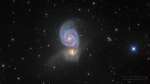
Find the Big Dipper and follow the handle away from the dipper's bowl until you get to the last bright star. Then, just slide your telescope a little south and west and you'll come upon this stunning pair of interacting galaxies, the 51st entry in Charles Messier's famous catalog.
 NGC 3521: Galaxy in a Bubble
5.05.2022
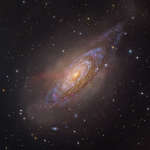
Gorgeous spiral galaxy NGC 3521 is a mere 35 million light-years away, toward the northern springtime constellation Leo. Relatively bright in planet Earth's sky, NGC 3521 is easily visible in small telescopes but often overlooked by amateur imagers in favor of other Leo spiral galaxies, like M66 and M65.
 APOD: 2024 September 8 Б M31: The Andromeda Galaxy
8.09.2024
The most distant object easily visible to the unaided eye is M31, the great Andromeda Galaxy. Even at some two and a half million light-years distant, this immense spiral galaxy -- spanning over 200,000 light years -- is visible, although as a faint, nebulous cloud in the constellation Andromeda.
 NGC4039: Starbirth and Galaxy Death
6.05.1997
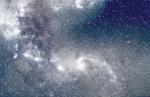
Do star clusters form when galaxies collide? Quite possibly, according to Hubble Space Telescope observations of the "Antennae", two galaxies thought to be in the early stages of a collision.
|
January February March April May June July August September October |
|||||||||||||||||||||||||||||||||||||||||||||||||