
|
You entered: star
 APOD: 2023 January 2 Б After Sunset Planet Parade
2.01.2023
Look up tonight and see a whole bunch of planets. Just after sunset, looking west, planets Venus, Saturn, Jupiter and Mars will all be simultaneously visible. Listed west to east, this planetary lineup will have Venus nearest the horizon, but setting shortly after the Sun.
 APOD: 2026 March 14 Б A Year for K2-315b
14.03.2026
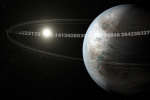
Want to visit a planet that has 3.14 days in a year? Then plan a trip to K2-315b, an earth-sized planet orbiting around a cool, red, M dwarf star about once every 3.14 days.
 An ALMA Telescope Array Time Lapse
26.05.2014
It is the most expensive and complex ground-based astronomy project ever -- what will it see tonight? The Atacama Large Millimeter Array (ALMA) project consists of 66 dishes, many the size of a small house, situated in the high altitude Atacama Desert in Northern Chile.
 Pauli Exclusion Principle: Why You Don't Implode
19.02.2003
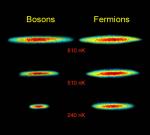
Why doesn't matter just bunch up? The same principle that keeps neutron stars and white dwarf stars from imploding also keeps people from imploding and makes normal matter mostly empty space. The observed reason is known as the Pauli Exclusion Principle.
 Orion Nebula in Oxygen, Hydrogen, and Sulfur
13.07.2004
The Great Nebula in Orion, an immense, nearby starbirth region, is arguably the most famous of all astronomical nebulae. The Orion Nebula, also known as M42, is shown above through ultraviolet and blue filters augmented with three exact colors specifically emitted by hydrogen, oxygen, and sulfur.
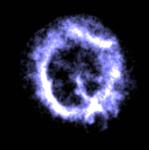 X-ray Hot Supernova Remnant in the SMC
9.12.1999
The Q-shaped cloud seen in this false-color X-ray image from the orbiting Chandra Observatory is big ... about 40 light-years across. It's hot too, as its X-ray glow is produced by multi-million degree gas.
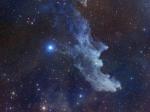 IC 2118: The Witch Head Nebula
11.12.2006
Double, double toil and trouble; Fire burn, and cauldron bubble -- maybe Macbeth should have consulted the Witch Head Nebula. This suggestively shaped reflection nebula is associated with the bright star Rigel in the constellation Orion.
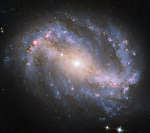 Barred Spiral Galaxy NGC 6217
28.12.2009
Many spiral galaxies have bars across their centers. Even our own Milky Way Galaxy is thought to have a modest central bar. Prominently barred spiral galaxy NGC 6217, pictured above, was captured in spectacular detail in this recently released image taken by the newly repaired Advanced Camera for Surveys on the orbiting Hubble Space Telescope.
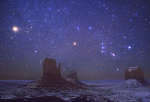 Mars and Orion over Monument Valley
2.02.2014
Welcome to The World At Night. Sharing the night sky seen around the world, this view from Monument Valley, USA includes a picturesque foreground of famous buttes. Buttes are composed of hard rock left behind after water eroded away the surrounding soft rock.
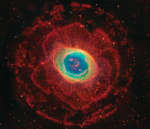 Rings Around the Ring Nebula
13.08.2014
It is a familiar sight to sky enthusiasts with even a small telescope. There is much more to the Ring Nebula (M57), however, than can be seen through a small telescope. The easily visible...
|
January February March April May June July August September October |
|||||||||||||||||||||||||||||||||||||||||||||||||