
|
You entered: star
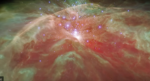 Flight Through the Orion Nebula in Infrared Light
7.07.2021
What would it look like to fly into the Orion Nebula? The exciting dynamic visualization of the Orion Nebula is based on real astronomical data and adept movie rendering techniques. Up close and personal...
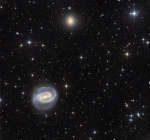 APOD: 2026 March 21 Б Galaxies in the River: NGC 1300 and NGC 1297
21.03.2026
Spiral NGC 1300 and elliptical NGC 1297 are galaxies that lie on the banks of the southern constellation Eridanus (The River). At 70 million light-years distant or more, both are members of the Eridanus Galaxy Cluster.
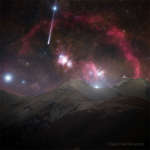 APOD: 2026 May 15 Б R3 PanSTARRS: An Orion Comet
15.05.2026
Comet R3 PanSTARRS might be best remembered as an Orion comet. A key reason is because Comet C/2025 R3 (PanSTARRS) was near its most spectacular -- in terms of tail visibility -- when passing in front of the iconic constellation.
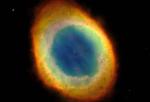 M57: The Ring Nebula
16.07.2000
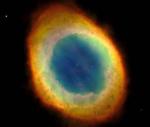
Except for the rings of Saturn, The Ring Nebula (M57) is probably the most famous celestial band. This planetary nebula's simple, graceful appearance is thought to be due to perspective -- our view from planet Earth looking straight into what is actually a barrel-shaped cloud of gas shrugged off by a dying central star.
 The Ring
7.01.1999
Except for the Rings of Saturn, The Ring Nebula (M57) is probably the most famous celestial band. This planetary nebula's simple, graceful appearance is thought to be due to perspective -- our view from planet Earth looking straight into what is actually a barrel-shaped cloud of gas shrugged off by a dying central star.
 A Window to the Once Secret Sky
13.04.2005
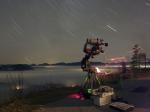
If there was a window nearby to the distant universe -- would you look through it? Quite possibly, there is, in the form of a small telescope. A local skykeeper could be a relative or a stranger and is frequently proud to show off the sky free of charge.
 Unusual Spiral Galaxy M66 from Hubble
13.04.2010
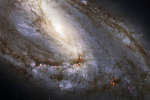
Why isn't spiral galaxy M66 symmetric? Usually density waves of gas, dust, and newly formed stars circle a spiral galaxy's center and create a nearly symmetric galaxy. The differences between...
 The Pipe Nebula
23.11.2012
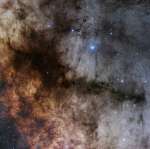
East of Antares, dark markings sprawl through crowded star fields toward the center of our Milky Way Galaxy. Cataloged in the early 20th century by astronomer E. E. Barnard, the obscuring interstellar dust clouds include B59, B72, B77 and B78, seen in silhouette against the starry background.
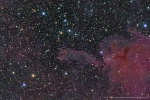 Cometary Globule CG4
5.03.2015
The faint and somehow menacing cometary globule CG4 reaches through the center of this deep southern skyscape. About 1,300 light-years from Earth toward the constellation Puppis, its head is about 1.5 light-years in diameter and its tail about 8 light-years long.
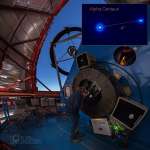 At the Limit of Diffraction
7.05.2015
Did you ever want to just look through the eyepiece of a large telescope in space? If you could, you would see a sharp view that was diffraction limited. Unaffected by atmospheric blurring that...
|
January February March April May June July August September October |
|||||||||||||||||||||||||||||||||||||||||||||||||